Anti-Bullying Policy – a journey

Everyone’s favourite thing I know but developing an anti-bullying policy is a crucial step for us all – it is vital if we want to create environments where bullying cannot thrive. Environments where bullying does not thrive are known for the quality of the relationships on show, they are known for being inclusive and safe and  they listen. This does not happen by accident, there will be effective leaders in these places, valued staff, children and young people. There will be shared aims and an understanding of what it means to go there – to be a part of it.

Part of what builds a shared understanding and shared vision is that it is written down and explained, it is shared and understood. It sets the boundaries, ethical and professional, for how people are expected to relate to each other and allows us to hold each other accountable. Places where the tone and mood is set by one powerful individual can be effective but a top down approach which relies on unwritten rules, presents challenges for new faces as well as for those who may not be entirely in step.

I like to explain culture as ‘the way things are done here’.  I want my children to go to a school where they value difference, where they care about the pupils, where they role model good relationships and listen to the pupils. Not a culture based on fear or a domineering Head or a Unit Manager and their acolytes. I have worked in places like this and one of the only ways I could hold colleagues appointable and start to influence change was to include and reference what polices we were supposed to be operating within.
I know many roll their eyes at the thought of policy and, given some of what we have to read and assimilate at times, it’s an understandable response. When we are looking at responding to bullying and, crucially, creating an environment where bullying cannot thrive, we need a written commitment to how we should expect people to behave.

In places where the culture is ‘Well, we all know how to behave and we all know what bullying is’ I ask, ‘How do you know and are you sure everyone thinks the same way?’ In the absence of a written statement that states ‘this is what we mean by bullying here is how you should be treated’ people remain free to interpret behaviour themselves and decide if they feel a response is warranted.
We know from experience that this is way too subjective and people’s own values and prejudices influence this hugely. If you think bullying is ok and didn’t do you any harm, you won’t respond effectively, if you think being gay is wrong, you can’t actually respond effectively to homophobia. If you think online bullying is nothing to do with you then you won’t be able to help anyone deal with it when it is happening to them.  This is why we need  policies, they are not theanswer but they are a part of the answer.

Based on the work we have been doing at respectme for the last nine years, around developing and influencing policy, we have found effective ways to ensure policies are better understood; they are co-produced with stakeholders, especially with children and young people.There is no legal requirement in Scotland for schools to have an anti-bullying policy, but it is  good practice and those who regulate and inspect you will expect to see one.

But we know that employing a ‘scatter gun’ approach to policy development does not work, by this I mean working with any one school at a time. There is no evidence to suggest this is an effective way to improve practice across the country, instead we get very patchy and inconsistent anti-bullying practice.  At respectme we help develop policies at an organisational level, these are then cascaded locally to ensure a more consistent picture and a greater reach.

In Scotland we have a National Approach to Anti-Bullying, which sets out the Government’s expectations. A revised version of this will be launched  this year and it will be called ‘Respect for All’. respectme has influenced this a great deal and our experience of developing and implementing policy has been central to this. I will describe the rationale for the process first rather than just what you need to put in a policy.

Our approach is to support organisations and local authorities to develop anti-bullying polices that are in step with the National Approach. This means they are underpinned by the same values of fairness, inclusion and equality, and there is a consistent definition of bullying and consistent guidance on what to do when bullying happens. It means that your local authority, school and sports club should have the same definition and use the same language when talking about and when you are challenging bullying.

The 2011 evaluation of respectme highlighted that adults and young people having a shared language and understanding on bullying was critical to success and in creating environments where bullying cannot thrive. respectme  helps an organisation or a local authority to develop a strategic overarching anti-bullying policy that is cascaded to each individual service, club or school within it.

We advise on and support a process of collaboration; getting the views of children and young people, parents, adult’s, staff and volunteers. This way the policy does not just appear out of the blue and it can be launched in the knowledge that the right people were asked and included.

Experience has also shown that the most effective way to integrate this into local practice, the most effective way to ensure individual schools, clubs or service have a good and well understood policy, is for them to take the organisational one and develop their own one locally.

This policy will be underpinned by the same values, definition and crucially it will mirror the process of collaborating with children and young people, parents and staff. This should lead to a shorter local policy that starts by referencing the organisational or local authority policy. This allows schools to say, ‘Glasgow City Council states.. and at Bellahouston Academy we do this…’ or ‘Aberdeen City Council sates… and at St Mary’s our pupil council said … about bullying.’ This is taking national policy and making it relevant locally. If every school just put a copy of the local authority policy on the shelf, there would be no ownership of it, no journey embarked upon where local issues and local parents got involved and this approach is far less likely to be successful.

This is not about doubling the workload but ensuring a very robust policy framework is in place to help those being bullied and to support those who are dealing with it. So in Scotland we would expect to see an individual school, service or club with an anti-bullying policy that is developed to reflect the organisational or local authority one. respectme will help ensure the local authority or organisational policy reflects the National Approach.

This means that in practice an individual badminton club, primary school or football club can have a policy that shares the values and principles of the organisation they are part of or that governs them. That organisation should have a policy that reflects the National Approach. This consistent language and framework should benefit children and young people, their parents and cares and those who work with them. Everyone gets the same message.

So when a parent asks for the schools policy, they should get the individual school policy but also see the local authority one, as this will give greater detail on what they can expect and what routes to take. It isn’t one or the other, best practice is both. If you are a local club not part of an organisation, you governing body, such a Sport Scotland will have a policy to reference, if you are even more local and not part of this set up, you should still use the National Approach as a guide for your policy – this will ensure it is in step with the policies the same children and young people will experience at school or other places.

All of this is designed to ensure that policy is more consistent at every level, local, organisational and strategic.

There are some things you need to put in you policy whether you are an organisation, a youth club  or a school and one of these is a commitment to challenging prejudice-based bullying. Every single policy must be explicit about the Equality Act 2010 and each of the protected characteristics.  This has been covered in other blogs on this site. We know from the research we did for the EHRC that where policies explicitly mention things like homophobia biphobia and transphobia, racism, gender-based prejudice etc.  staff feel more confident to respond to this type of behaviour when they see it. The policy gives them permission to challenge and discuss these issues and crucially, raises an expectation that they will challenge prejudice-based bullying.

There was also evidence to suggest that establishments where their policy does not mention specific types of prejudice-based bullying ,  practice is not as good and both staff and children and young people felt less confidence about dealing with this kind of bullying.

Policy is a journey, a values based journey to share understanding of what bullying is and what is expected of everyone involved what behaviour you can expect and how you can expect people to respond. It gives us a framework for anti-bullying practice and something we can and should be held accountable to.

So don’t be put off, get it right, make it inclusive and that in iself is a big part of developing environments where bullying cannot thrive, why would we not do that?

For more information on what goes in your policy, visits www.respectme.org.uk

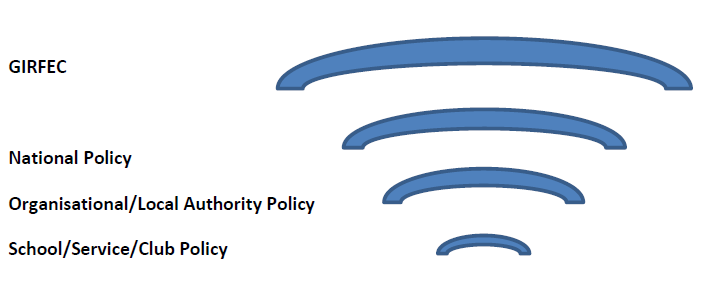
This is designed to illustrate the process and context for anti-bullying policies at every level and how we can ensure consistency in overarching values and principles from a Government level to an individual school or youth club level.


Brian


Parents and carers – responding to bullying

This blog contains some of the supporting advice we have given to parents and carers about how you actually respond to bullying – the processes we need to go through and to include children and young people going forward to help them regain a sense of control ands influence over their lives.

How do I know if it’s bullying?

When we talk about bullying we are talking about something that is both behaviour and impact. Behaviour that can make people feel hurt, frightened, scared, left out or worried – and the impact of this behaviour leaves them feeling less in control of themselves.

We know that bullying takes something away from people; that is one of the things that makes it different from other behaviours. It takes away people’s ability to feel in control of themselves and to take effective action.  We callthis our agency. Bullying strips away a person’s capacity for agency.

It’s important to remember this when we respond to bullying behaviour.  If we can accept that it takes something away from someone, our focus has to be on helping them to get it back; helping them get back that feeling of being in control and being themselves again. That’s why we have to involve young people in what they want to happen, what they would like to happen, and what they are worried about happening. 
And sometimes we need to take a lead from them as to what pace we go at. If we can do that, we can help restore that feeling of being in control. 

We are teaching children very important life skills.  We are teaching them to negotiate difficult relationships and that’s a factor of life for everyone.  It’s a skill we all need as adults, to learn how to get on with people and to learn how to dislike someone in a respectful manner.  That’s how we approach bullying.

What advice should I give?

Hearing that your child is being bullied brings out an understandably emotional response. It’s difficult for parents and carers to hear.  It’s difficult because you feel so strongly about it and when you hear your child is being bullied, you are not always at your best.

Sometimes the advice we give children and young people at this time isn’t necessarily the best advice. Being told to hit someone back if you are being bullied is actually a common response; children and young people have told us this is something they hear. We know it exists as an option to use but we know, by and large, it’s not necessarily the best or safest option to take.

It doesn’t take into account people that can’t or won’t hit back; people that have mobility problems or who are too scared, or people who won’t like the thought of violence.  So there always has to be an alternative to it. We don’t go through life answering challenges and relationship difficulties by resorting to violence, yet we tend to tell children if they are being bullied they should hit back – whether they are being physically bullied or bullied online, that’s the advice we tend to give.

There is never one, single, answer when it comes to bullying, it’s about knowing how to think about it and how to approach it.

Sometimes you have to ask your child, ‘what do you want to happen?’
‘tell me what you have done so far?’
‘what would you like me to do?’
‘what do you think would happen if, say, I was to go up to the school and talk to them about it?’.

If they are worried that you would make it worse, you might have to try something else because most children want bullying to stop with the minimum of fuss.
‘What do you think would happen if I spoke to someone’s mum?’ or
‘is there someone else you can talk to?’

It’s about exploring options; thinking about what you can do and sometimes having to say, as a parent, ‘look if I’m worried and I don’t think you’re safe, I’m going to step in’, and explain why you are doing it.

This process of exploring what you can both do role models a way of thinking and the aim is to agree a way forward – a plan you can agree to and agree to review if it’s not working. You will have a positive impact on their anxiety levels as they can discuss things with you and they can see your desire to help rather than you being angry or upset. It is not about as a parent or carer having all the answers – it is about asking each other questions, talking and most importantly listening, to get closer to an answer together.

Listening isn’t always easy – especially if we are emotional but the one thing children and young people have told me consistently over the years is that they want listened to when they are being bullied.

The temptation to run off and solve it is an understandable one, but we should always take a moment, pause and think, ‘how do I give my child back a sense of being in control?’ because it’s that sense of being in control that has been taken from them, and that has to focus your response. Sometimes your child might ask you not to do anything straight away – to give then the chance to go back into school and see how things are.
 

What if my child is bullying someone else?

If your child has been accused of bullying or you suspect your child is bullying, you have to address their behaviour and the impact that it has had. Children who are bullying others need help to repair relationships; they need help to understand that what they’ve done is wrong. Sometimes they know the impact of what their behaviour is; that’s why they’re doing it, but sometimes they need help to understand the effect their behaviour is having on someone else.

It’s important when we deal with children who are bullying that we don’t label them.  We talk about their behaviour and we talk about the impact that it has, we don’t label them as bullies. There isn’t any one stereotypical ‘bully’.  Bullying is behaviour that makes people feel a certain way – and many of us will have acted in a certain way that made someone feel hurt, frightened or left out. It’s much easier to change your behaviour if I say, ‘when you did that to him, that was bullying’. I’m much more likely to get a better response then if I say, ‘because you did that, you are a bully’.

People won’t recognise that label, parents will object to that label and you don’t change behaviour by labelling people. You change behaviour by telling people what they did, why it was wrong, and what you expect instead.

Prejudice-based Bullying and promoting equality

This is to give this some contect and to explore why we take the approach we do when creating environments where people feel safe and included and the challenges we face with this. We also explore what protected characteristics are and why they exist and how do our values affect how we challenge prejudice.

Probably the best place to start would be with prejudice – to ‘pre-judge’
Noun
1. An unfavourable opinion or feeling formed beforehand or without knowledge, thought, or reason.
2. Any preconceived opinion or feeling, either favourable or unfavourable.
 
So, everyone can be and is likely to have some prejudices – some things we have favourable views towards and some less so. When we act on this prejudice and treat people less favourably, we are discriminating.
Bullying, as has been covered in many of these blogs, is a mixture of behaviour and impact that affect a person’s capacity to feel in control of themselves. This is what we term as their sense of ‘agency’. Bullying takes place in the context of relationships; it is behaviour that can make people feel hurt, threatened, frightened and left out.
When this behaviour is motivated by prejudice, we are talking about prejudice-based bullying.
Prejudice will be based on a personal characteristic or a group that someone either belongs to or people believe they belong to or identify with.  So what might these characteristics be? Their gender?  Are they gay? Is it their religion? Do they have a disability? Or is it how they look or what they wear? It can be any of these and more.
So why are some personal characteristics mentioned more than others?
Some personal characteristics are protected within the law – the reason for this is to address the imbalance – to address the years of unfavourabletreatment experienced by some groups over the years
The experience of women, of LGBT people, of black people or of people with a disability, has shown that they have received less favourabletreatment in many ways over the years – in terms of being picked on, excluded and not having equal access to employment  and education. This was initially responded to through legislation such the Race Relations Act 1976, that ‘outlawed discrimination’ or the Equal Pay Act 1970, that was intended to address the less favourable treatment of women in the workplace. Legislation such as the Sex Discrimination Act 1975, was also intended to address discrimination on gender and married status. These Acts were needed specifically because of the imbalance and  the unfair treatment these groups were clearly receiving.
This has evolved and led to the Equality Act 2010 which is designed to protect people from discrimination in the workplace and the wider community such as in Education or as a consumer. This Act sets out that it is unlawful to discriminate against a person due to the following personal characteristics –
  • age


  • being or becoming a transsexual person


  • being married or in a civil partnership


  • being pregnant or having a child


  • disability


  • race including colour, nationality, ethnic or national origin


  • religion, belief or lack of religion/belief


  • sex


  • sexual orientation


Based on the historical prejudice and discrimination experienced by people who have these, or are perceived to have these characteristics, they now warrant special protection under the law to address the inequality they experienced. These characteristics are protected and as such are referred to as The Protected Characteristics. Age and being married do not apply in Education.
Public examples of this have been highlighted in the media such as cases where people who refuse a service like a hotel room to same sex couples or build new schools that are inaccessible to wheelchairs, will be in breach of the Equality Act.
I get asked a lot why red hair, wearing glasses or being tall or overweight isn’t a protected characteristic too, people experience bullying for these reasons also.  One of the most common reasons young people cite for bullying is personal appearance –that could be related to the music they like or the income of their parents.
The answer to this is that while people do get picked on and excluded for a variety of reasons, the groups protected under law have clear historical evidence of societal and cultural exclusion and less favourabletreatment. It may sound a little glib – but once all of the tall people get together and can reflect on and evidence years of collective exclusion, not getting work, missing out on promotion, being made to take only certain lessons at school like home economics, receiving abuse or suffering violence and intimidation on a collective basis ; then that too may become a legally protected characteristic.
This does not in any way mean that the bullying of a person because of the way they look is less serious or not as important as bullying based on a protected characteristic. The protected characteristics are not designed to create a hierarchy but to help address the imbalance experienced by certain groups. We know from our work that children and young people who are disabled, who are or are perceived to be LGB or T can experience bullying more frequently than other groups – this just means we need to be aware of and be able to challenge what values and prejudice lies behind this behaviour.
We also know that children and young people bully others because they don’t get on or they don’t like each other – we sometimes forget the interpersonal elements of bullying situations.
You might not like a person who is gay or a different faith from you but that is not the reason you dislike them – a person is cable of disliking someone and being mean about them without using a personal characteristic, protected or not, as the topic for their insult or behaviour. There is a difference between ‘I can’t stand him he is a pain and he talks rubbish’ and ‘I can’t stand him, he’s a black (insert whatever word/insult here)’.  The latter is a clear example of a prejudice-based statement based on someone’s race or ethnicity.
Research has shown us that where polices are explicit about what they mean by prejudice-based bullying, where we name specific behaviour they find unacceptable – adults and young people feel more confident to challenge these prejudices and behaviour .
Policies that don’t mention things like homophobia, disability, race or even socio economic status are linked to environments where adults are unsure about challenging certain behaviour and language. This explicit commitment to equality and challenging inequality is clearly linked to better practice in dealing with and preventing prejudiced-based bullying.
Schools, services or clubs that are clear that they will challenge homophobia, that they will challenge bullying based on disability, race or ethnicity, gender, sexual orientation, transgender status, religion and belief, socio economic status, appearance, if children are Looked After, are young carers or are refugees or their families are asylum seekers, will be creating environments that value difference and set out clear expectations about what behaviour is acceptable and what is not. Adults can then be held accountable to this as can children and young people.
This though presents a further challenge for the grown-ups. Are you confident to challenge prejudice? All prejudices or just the ones you object to? Confidently challenging some prejudice will be easy for many people – our own values and those of our chosen profession are compatible and we have the knowledge and passion to challenge and educate. Some of us need to get better informed on some areas – help is available form a range of agencies if you want to learn more about asylum seekers or migrants, about transgender people or a particular disability.
We normally learn more about things when we need to. When we are presented with behaviour or attitudes we don’t know much about, we go and find out about the issue to be better informed – the desire to do this is underpinned by values of fairness and equality. So what about the people whose personal values are perhaps not as ‘in-step’ as others?
You may well work or have worked beside someone who is misogynistic, who says racist things, is sectarian perhaps and this only appears on nights out or in the staff room or on social media.
I do find myself saying to colleagues that we are not the thought police – we cannot tell people what to think or that they are not allowed an opinion – what we can do is hold people accountable to the legal and ethical boundaries of their role or profession.  The reality is if a person is even a little prejudiced towards things like equal marriage, Syrian Refugees or women being as good as men at their job – this will be evident in how they challenge these prejudices.   If adults have these prejudices they will not effectively challenge behaviour because it conflicts with their values.
Our values underpin what we do and they will always make themselves evident – some people are good at telling you what their values are at interviews but not so good at showing these when they hear certain language.  They will say thing like ‘You are not allowed to say things like that here’or ‘someone might find that offensive’or actually say and do nothing because they agree with what is being said. When prejudiced language or bullying challenges your values – you will challenge it with passion and clarity, and people will believe you.
Inequality is a huge issue for society – we are addressing historical and cultural issues and responsibility for this rests with people at all levels – not just those who work with our children and young people.
We have had some high profile examples of this – the Ryanair passenger who racially abused a fellow passenger – his defence was that was not racist or when footballer John Terry racially abused a fellow player – his friends defence of him was that they knew him, and he wasn’t racist. I always respond the same way – maybe that’s not his ideology, that’s not what he is 24/7 but what he said was racist – and he is accountable for that. Not what he thinks he meant or feels on other occasions – what he said was wrong. 
So what can I do?
While these are huge cultural issues we can, as individuals and organisations, give children and young people a better experience, a different experience that values them, one that challenges inequality and involves them in setting the culture and ethos in places they go. When some of us talk about equality; we talk about treating everyone the same or the need to. For me, as a practitioner equality has always meant that I have a duty to challenge inequality.
The training I received helped me view my role as someone who is, for example, anti-racist – not simply ‘not racist’. I commit to challenging racism and racist language. I will challenge homophobia or practices that promote gender inequality and so on. This is what we can all do. On my shift, in my classroom, I will challenge prejudice and value individuals. The walls in our club or class, the activities we do, will clearly value diversity and we will learn about difference and respect. 
We won’t achieve this by starting off from a point where we treat everyone the same – our goal is to achieve equity first and we need to address the imbalance –


Creating environments such as these and role modelling how to challenge prejudice and promote what makes people different, and to learn to accept this, is exactly what we sign up for if we work with or even have children.
Brian


What do we mean by bullying?

This blog summarises and improves on a couple of the speeches I have made on this issue lately – I hope you find it useful.

What do we mean by bullying?

There have been many different definitions and theories about what constitutes bullying, but it’s not helpful to define bullying purely in terms of behaviour, bullying is both behaviour and impact.

Bullying is not about just any kind of injury, nor just any negative impact. It involves a particular kind of harm. It is aimed at engendering a kind of helplessness, an inability to act, to do anything. It is an assault on a person’s agency (Sercombe and Donnelly 2012)

Bullying is a mixture of behaviours and impacts which can impact on a person’s capacity to feel in control of themselves. This is what we term as their sense of ‘agency’. Bullying takes place in the context of relationships; it is behaviour that can make people feel hurt, threatened, frightened and left out.

 This behaviour can include:  

• Being called names, teased, put down or threatened

• Being hit, tripped, pushed or kicked

• Having belongings taken or damaged

• Being ignored, left out or having rumours spread about you

• Receiving abusive messages on social media or phone

• Behaviour which makes people feel like they are not in control of themselves

• Being targeted because of who you are or who you are perceived to be

This behaviour can harm people physically or emotionally and, although the actual behaviour may not be repeated, the threat may be sustained over time, typically by actions: looks, messages, confrontations, physical interventions, or the fear of these. Bullying is both behaviour and impact.

Online bullying

Online bullying, or Cyberbullying, is often the same type of behaviour but it takes place online, usually on social networking sites. A person can be called names, threatened or have rumours spread about them and this can (like other behaviors) happen in person and can happen online.

Advances in technology are simply providing an alternative means of reaching people – where malicious messages were once written on school books or toilet walls, they can now be sent via social media sites on mobile devices making their reach greater, more immediate and much harder to remove or erase.

Some online behaviour is illegal. Children and young people need to be made aware of the far-reaching consequences of posting inappropriate or harmful content on forums, websites, social networking platforms, etc.  If a child or young person is being treated or threatened in a sexual way or being pressured into doing something that they don’t want to do, this is not bullying.  There are laws to protect children from this very serious type of behaviour.

Persistence and Intent
Bullying is not defined by persistence or intent. This is relevant because if you were to look up definitions online and in peer reviewed articles, the vast majority of these will refer to bullying as persistent and deliberate behaviour.

We would argue that these are unhelpful criteria to apply to all situations. So much time can be lost trying to apply a range of situational factors, many of which are in fact subjective. Many incidents of bullying will include deliberate and repeated behaviour but these are not in our view, essential criteria to define bullying. 

Making these an essential criteria to be met excludes a significant amount of incidents of bullying that are not deliberate or necessarily repetitive.  We know from our work with children and young people , that bullying takes many forms and something need only happen once to have a severe impact.

Let’s look at intent– if you tell me bullying must be deliberate and then accuse me of bullying, what is my first response? –  That I didn’t mean it. Intent is difficult to prove. It can tie situation up in knots and the focus on responding to what someone did and the impact it had is lost.

Schools can waste a lot of time trying to prove intent –I have been involved in examples when intent is denied the adults are stumped and do not know how to proceed. We must look at what someone actually did and the impact it had. If it wasn’t deliberate then they may be in a position to apologise or make amends sooner – of it was it may merit a more serious response.

Bullying is usually deliberate but not always – sometime children use language they hear at home and have no idea of how offensive or inappropriate it is. We should not get caught up in using this as qualifying criteria though – it’s too easily re-framed

Let us now consider persistence– that the behaviour must be repeated before it can be considered bullying – again this is something we do not agree with and neither do most young people we have spoken to. Persistence is difficult to define and also, is it more than once? twice? daily? weekly? Who defines when it’s persistent enough to intervene? Me, the person it is happening to or the intervening adult? Something need only happen once and the impact can be severe; a child may not get changed for PE after one incident were they were picked on, humiliated or threatened.
Is being humiliated by having your shorts pulled down in front of a class with 15 people laughing and pointing, some possibly taking a picture, bullying? Of course it is, is it repetitive? It doesn’t matter, we focus on the behaviour and the impact it had.

The fear of repetition can be sustained through looks or perhaps threats or just the fear of it happening again.

What you do about bullying is actually more important than how you define it.

We respond by asking;

What was the behaviour?

What impact did it have?

What do I need to do about it?

Every situation is unique. You might over hear some name calling in the corridor and discover this is chat between to close friends who are ‘winding’ each other up; it is not part of any power or dominance game.

What was the behaviour? Name calling

What impact did it have? None – made them laugh

What do I need to do about it? Nothing – perhaps remind them about language or being overheard

You may hear the same name calling ten feet further on but the person on the receiving end is upset and embarrassed in front of her peers.

What was the behaviour? Name calling

What impact did it have? Left someone embarrassed and fearful – who ran off

What do I need to do about it? Help this person get back into her routine, listen to how she feels and decide on next steps – you will need to challenge the people who called her names and look at possible consequences too

This does not mean we only focus on the impact behaviour has – this means that if someone shouts a homophobic or racist slur at someone and it bounces off them and they don’t care –this does not mean you do not need to do anything about the language used and the attempt to bully. Just because a person is not affected does not mean the behaviour they experienced should be ignored.

Just as not all attempts to bully are successful, people can feel bullied but not be – it is possible some people over react –you still need to deal with their reaction and their feelings but you might not need to do much about the behaviour the experienced – it could have been a harmless comment not aimed at them but they have assumed it was and got into a terrible state over it.

Focussing our response

Bullying and Agency

So when we look at impact – things like feeling hurt, angry, scared, frightened, that knot in your stomach- what is happening there? What do these reactions tell us?

Young people have reflected to us over the years in a range of ways that they feel unable to speak out and feel trapped when bullied – they draw pictures of themselves in large rooms feeling caged and so on. This learning helped us articulate the notion that bullying actually takes something away from people.

All of these feelings which are regularly articulated reflect a loss of being in-charge of yourself, of being capable of taking effective action, of making choices and of being an effective actor or agent in your own life.

When we use our agency, we have a degree of choice over what we do and how we respond within structures like families, communities and schools.

Young people get this notion  – as it can be a bit if a head scratcher the first time you hear it – though when you explain a ‘typical day’ of meeting friends, going to school, laughing, joining in and knowing what is happening and how you’ll respond most children and young people recognise this day. Bullied children don’t have the same kind of day. Someone else is in charge of how they feel, where they go even or how they will participate in certain things, if they get on the bus or eat alone. They cannot exercise the same choice nor have the same autonomy as when they were not being bullied.

We learn from our past experiences, from imagining what we would do in future similar situations and what is happening to us now – these elements combine and enable us to make choices and act – this is agency.

Managing change and responding to challenges requires hope, a belief you can handle things – and agency and these underpin resilience.

If we re-visit the quote –

Bullying is not about just any kind of injury, nor just any negative impact. It involves a particular kind of harm. It is aimed at engendering a kind of helplessness, an inability to act, to do anything. It is an assault on a person’s agency (Sercombe and Donnelly 2012)

– we can see bullying is not even the establishment of dominance. The person bullying is not satisfied with dominance. Bullying can involve the attempt to deny another any settled place, even a subordinate one. It goes beyond subjection. In bullying, the goal is abjection

What does this mean for how we respond?

Considering that bullying is both different types of behaviour and a particular impact this should re-focusses our understanding of the dynamic – this can re-define an approach to bullying in a way that helps practitioners’ responds to feelings and actions. This is always more effective than checking off criteria and having uniform sanction based responses based on our view of the person who is doing it.

If we can accept that bullying takes something away from people, that they can no longer take effective action our response must focus on helping get that back.

This is the real shift in anti-bullying practice – how do I help someone get back a feeling of being in control of themselves and in a place to take effective action to feel safe and get on with their day?

Things like moving desks or even just excluding people won’t on their own help restore agency – young people must be included in what will happen next and given the chance to steer what direction it goes in. They need to be asked what they would like to happen and we need to take that seriously.

This is not always easy but it must remain our goal with every intervention – to help young people get back to a place where they are in control and can take effective action.

In reality – what does that look like? What does it sound like? You will need to ask questions like

What would you like to happen?

What do you think will happen if I tell his or her parents?

What will happen if I tell your teacher?

What are you worried about?

Be prepared for them to say

Don’t tell my dad – you will out me to him and I’m not ready for that

I just want you to know what is happening and if I need you I will come and get you

If you talk to his dad he will get a doing/beating and it’ll get worse

So you explore what options they do have and sometimes that means pointing out that you need to do something as not doing anything is dangerous

Open conversations like these promote communication – this promotes positive relationships and they promote and role model problem solving behaviours –these relationships can become stronger and children become more resilient to what is happening because of this strong purposeful relationship – even with just one person.

The process of listening and consciously trying to get back agency – a sense of being on control – won’t always lead to a perfect outcome but it will help the person being bullied

Labelling

Bullying is not defined by the type of person who did it either

Care needs to be taken because labelling is not without its risks, labelling a child or young person on the basis of bullying behaviour can result in a confirmed identity as a ‘bully’ or ‘victim’ resulting in ongoing behaviour patterns based on this identity.

This is not to dilute behaviour but is to keep the focus of the adult’s responses on the behaviour that is problematic, rather than the assigning characteristics to those involved. This is a solution focussed approach that is designed to help people change the way they behave, rather than attempt to change who they are. We help people change by telling them the behaviour that is unacceptable, being clear that what they are doing is bullying and that it needs to stop.

It is a fundamental part of behaviour management that we tell people what the behaviour was they did, why it is not acceptable and help them figure out what to do the next time they feel that way.

All of this promotes respectful relationships, this approach builds a young person’s capacity to respond more effectively, when we are helping young people learn to negotiate tricky relationships and when we involve them in finding solutions and repairing those that can be fixed, we help them to become more resilient.

Brian Donnelly

Bullying and the ‘One-off incident’…

One challenge we have faced on several occasions over the years is around perceptions of what a ‘one-off incident’ is and ‘can it be bullying?’

At respectme, we have always stated that behaviour does not need to be persistent for it to be bullying – even though typically bullying may be repetitive, this does not mean it always is or has to be.

It is unhelpful to think of bullying this way and narrows our focus.

The most common response to this approach is that, by our definition, every single one-off incident or argument between young people can now be considered as bullying, and teachers especially are going to have to record every little fall out or cross word that happens.

Saying that something can happen once and it can be bullying is not the same as saying everything that happens once is bullying.

 We never have and never will suggest that two children who fall out over something or who aren’t nice to each other are bullying.  It is reasonable to expect adults to deal with this low level, everyday behaviour by challenging it when they see it, and by role modelling the right way to behave – and there is certainly no need to record that you have done so. Bullying is different.

Bullying is a mixture of behaviour and impact – the impact on a person’s capacity to feel in control of themselves. This is what we term as their sense of ‘agency’. Bullying takes place in the context of relationships; it is behaviour that can make people feel hurt, threatened, frightened and left out.

Nowhere in this is it suggested that falling out or arguing with someone is bullying – children and young people will fall out, they will disagree on who and what is cool, they will bicker with each other and this is part and parcel of children being in social situations. People can argue without it being bullying.

A young person can be threatened and intimidated by other young people on a bus, leaving them feeling humiliated and embarrassed– This only needs to happen once to stop them from getting on that bus again, or being terrified at the thought of it, or re-living the experience and not being able to concentrate in class.

The threat of it happening again is very real; the likelihood of it happening again is also real if that’s the bus they need to get to get to school every day.  Regardless of whether it happened on the last day of school, when all of the people who took part were leaving for good, or whether it was the last time that bus ever ran, or whether the person being bullied is moving to another country the following morning and won’t see these people again, it is still bullying. The behaviour experienced sill stripped someone of their capacity for agency.

If I get humiliated and picked on when changing for PE one day, it could have lasting effects on my participation in it or enjoyment of it.  Do I really need an adult to not take it seriously or consider it bullying because it only happened once?

How do we apply this to behaviour that takes place online? One post seen or read by dozens can have a devastating impact – is it the number of ‘likes’ that make it repetitive? In the playground or on the bus, people can hear nasty and hateful things being said.  Would we consider a story being shared or gossip passed around as repetitive or persistent? It certainly can ensure the impact is greater.

Adults need to have the confidence to deal with behaviour when it happens. How often it happens might make it more serious; it could mean attempted interventions have not been successful and it now requires a more robust response.

Now, I know most adults are capable of responding in this way but I have seen first-hand and heard many times from children, parents and from some senior teachers, that because it only happened once, they couldn’t do anything – their anti-bullying policy said it needs to be repeated.

This very literal take on a policy document is in some ways understandable – that’s what many people do with polices.  The thing is for me, if you need people to apply judgment and discern (and you do) don’t give them a definition that is limiting or reductive. Let them consider what was the behaviour, what impact did it have and what do they need to do about it? It is what you do that matters.

When I ask young people if something that only happens once can be bullying – the overwhelming response is ‘of course it can’.

I have always struggled with the subjective nature of the word ‘persistence’ to be honest – does it simply mean more than once? More than once a week? Or does once a day make it persistent enough to deal with? And also, who decides? My teacher – who has not seen or heard every incident – or me, the person it is happening to? Also, how does my teacher know it is not persistent? They never saw what happened on the way into school or in my last class in another part of the building.

I do understand if people’s motivation to exclude ‘one-off incidents’ from bullying is due to recording and the time this will take up. If what you mean by ‘one-off incidents’ are low level, everyday interactions such as a fall out, an argument or a cross word, then I support that- but then you need to define what you mean by a ‘one–off incident’. Make sure there is a shared understanding of what you mean and what is expected of people as a result.

Your policy needs to be clear that when you say a ‘one-off incident’ that it is not bullying you are talking about but the low level stuff just described. Be clear that you are not excluding certain bullying behaviours because they only happened once.  

Make sure everyone understands repetition or persistence is not a criteria that is to be applied and used to determine if something is bullying or not. If there is not a shared understanding of this, then responses are less likely to be applied consistently and inconsistent responses form part of a culture where bullying is more likely to thrive.

Brian Donnelly