
Goodbye and thanks for all the fish…

It is with mixed emotions that I sit down to write this. After ten years as Director of respectme, Scotland’s Anti-Bullying Service, I am moving onto a new challenge. I am returning to the Looked After Sector for an exciting new opportunity with Care Visions.

Ten years is a reasonable amount of time to reflect on, in any role. When I started at respectme (or Better Futures to give it its working title) it was a tender document and an ambitious idea formulated by Fergus McMillan at LGBT Youth Scotland – and Charlie McMillan, formerly of SAMH. 

Ten years ago the policy landscape across schools and Local Authorities was, frankly, very poor. It was as patchy with no coherent approach in place. People used bits of models form Scandinavia and Canada, so it was a real challenge to try to get all of Scotland’s 32 Local Authorities pulling in the same direction. This required a considered approach; a way of thinking about things rather than a fixed model for intervention and policy.

People like having a model to work to, although, ‘just tell me what to do/what to say’ is an understandable and common request. I have always preferred to be encouraged and supported to think about situations in terms of what was happening, and what I could do about it. This helped to focus on developing pragmatic materials and resources that were designed to help someone, whatever their situation – on a Tuesday morning in school or on a Friday back shift in a residential unit.

Our approach to anti-bullying in Scotland is different.  We define bullying differently and we want to build the capacity and confidence of all adults to recognise and respond to bullying effectively.

I am proud of this approach, which addresses what someone did and the impact it had. We have not focused on labeling or stereotyping those involved or making assumptions about why. We ask adults to consider the following; What was the behaviour? What impact did it have? What  do I need to do about it? While also considering,  what does the child or young person want to happen?’.  This is designed to let people respond to each individual incident and the people involved, to focus on a response that’s appropriate for them.

I am very proud to have helped change the conversation about labelling children, that we can achieve more by talking about what they did not how that then labels them for life.

My research showed that children and young people who are being bullied want options.  They want to consider things that help them feel better as well as things that make bullying stop. Adults need to help them explore these options. They know that what worked for them won’t necessarily work for someone else.  They are not convinced by assemblies or lessons on bullying or detailed recording systems or playground monitors – they genuinely prefer the ‘whole school’ things we do.

Our combination of policy, training and resources and campaigns, has been designed to help colleagues change the culture and ethos in their organisation.   This approach has been well evaluated, with respectme being cited as a ’catalyst for change ‘and a ‘credible and robust’ service. Crucially all 32 Local Authorities in Scotland now have an anti-bullying policy, and I’m proud that respectmehas worked with, and directly influenced, 31 of these. We have trained around 7,000 adults who play a role in children and young people’s lives and our materials and campaigns have reached millions.

What has been even more pleasing though, is seeing schools where their attitude to bullying has changed; where they are inclusive and ask children and parents what they want to happen, and what they think relationships should be like in their school. This happens every day – it doesn’t make the news but it does happen. Children, for the most part, enjoy very positive and supportive relationships in school.

Yes, there are areas where schools still feel they’ know best’. But in my view policy and practice is far more consistent than it has ever been.  Schools have a national policy framework to work within – they have a local authority policy that reflects this, and access to free tools and training that reflects the values of respectme’s approach to develop local policy and practice. In places where they acknowledge and utilise this, you will find better practice.

I have seen first-hand the confidence and commitment from teachers who have attended our training, or worked with us on policy, champion change locally. I have also seen teachers and senior teachers who still refuse to accept bullying is an issue. While some still feel that if it happens out of school it is not something they can deal with. Bullying happens ‘to’ someone – where it happens is not really the issue. It impacts on them – on their agency. Our role is to respond to that, to focus on ‘what’ happened, less on ‘where’ it happened.

We have focused on getting it right with Local Authorities so that they can cascade their expectations to individual schools; an approach that works more effectively. To help address the gap between authorities and schools, respectme has developed new materials to take individual schools through a process of self-evaluation and local policy development.

We do need to improve on other things that will have a greater impact on anti-bullying work, but which anti-bullying itself cannot and should not be expected to achieve. We do need more inclusive education, one that reflects the lives and experiences of our LGBTI pupils and families.  We need better mainstreaming for children with a disability, if indeed that is the right step for them, more inventive and realistic resources on inclusion, racism and diversity. We need to address gender-based issues more openly; the pressure on girls to behave a certain way, and for boys too, is as strong as ever. The impact of these gender norms and expectations reaches way beyond bullying. Addressing these issues will help create environments that are more inclusive and respectful; things which also make dealing with bullying easier.

I am proud of the fact that, since day one, respectmehas ensured that the Protected Characteristics and prejudice -based bullying is included in every policy it works on and in every single training session it has delivered – as well as being included in the National Approach. This explicit commitment to equalities has been one that has helped define us as a service and will remain a key focus moving forward.  I am proud that every single resource we have developed has been influenced by the views and experiences of children and young people. They are the ones who helped us stick by our messages when others were going in a different direction. I am thinking mainly about cyberbullying. ‘Cyber’ is not is not really a word young people like or use, they  see bullying online as, well bullying, it is just were it happens that is different. It is the same behaviour – mainly name calling and rumours – and it is still less prevalent than face to face bullying but is more visible.

I am proud of the research and the published work undertaken over the last ten years.  We have trained colleagues across Europe and in the USA, and our materials are used and accessed across the globe. Our Scottish Approach is influencing and is contributing to how bullying is viewed and discussed far beyond our own shores.

I want to thank all of the people I have worked with in the last ten years; and I want to thank the TESS for stating back when we started, that we had ‘an impressive boldness’ about us. I never ever wanted to lose that. I will miss this.

Brian Donnelly
Bullying and Self-Esteem

I have been talking a lot to colleagues about this issue and felt it might be an interesting issue to put out here for some discussion. I will kick off by stating my personal position: we have got this wrong for years. The linking of people who bully to low self-esteem and a belief that improving children’s self-esteem when they have been bullied is all we need to do, is taking us down the wrong path.

The focus and almost universal acceptance of self-esteem as the singular capacity we all need in order to have better lives and experiences doesn’t ever really stand up to scrutiny. So what is self-esteem?

Definitions tend to cover the following –

How you feel about yourself — your self-worth or your pride or confidence in yourself; A person’s overall sense of self-worth or personal value that involves beliefs about the self, such as the appraisal of one’s own appearance, beliefs, emotions, and behaviours.

We have for years seemed to accept that we must make sure nothing we do ‘damages’ a child’s self-esteem. From the mythically ridiculous beliefs that awards for excellence in participation and non-competitive sports days will help our children and young people flourish, to some genuinely helpful learning, like being able to identify and talk about how you feel.

People who bully have low self-esteem’. This is a generalisation, it can sometimes be the case but a lot of children who bully possess very high self-esteem, they feel great about themselves, are confident in how they feel and look to the point they can identify and target others. It is a truly unhelpful generalisation to suggest children who bully are secretly all cowards who have low self-esteem and are scared of the people they bully. Some are of course but most are not. When we start to believe the stereotypes we then ignore people who are bullying because they don’t fit in with how we think they should look or act. Children who bully need to have their behaviour challenged, their prejudices challenged and their values and beliefs that what they are doing is okay challenged.

Do we ever talk of ways to help lower self-esteem in children? ‘Oh that child is far too confident and thinks they are the bee’s knees, they need brought down a peg or two’. Now I am not suggesting some adults don’t think like that but it’s definitely not in the self-esteem workbook. So could a focus on improving self-esteem of some children who bully really do anything other than make them worse? Or does this lead to the absurd notion that they can perhaps get bullied a bit to lower their self-esteem to the required level for acceptable social functioning? I am not suggesting this but merely that our approach to self-esteem is a one way street.

‘Bullying can cause low self-esteem’.  Of course it can, being bullied can make you feel terrible about yourself, it can affect your confidence, and how you see yourself. If you are bullied it will impact on the self-esteem you have, high or low. Bullying affects your agency, your ability to feel in control and make choices – we need to help restore that feeling, you need this whether you have high or low self-esteem.

The challenge is when we focus solely on self-esteem as theanswer to or the cause of bullying. Trying only things we believe will improve a child’s self-esteem might not work. Telling a bullied child they are wonderful and the person picking on them is just horrible and envious of who they are can satisfy how we feel as adults but does little for the person being bullied. It’s not focussing on solutions.

Involving them in what they want to happen, exploring ways to manage these risks and to take steps to feel better and identify the ways they want to cope and respond is far more effective. They will be learning great life skills, learning how to manage relationships and difficulties. A focus on trying to make sure all our children and young people have high and/or improved self-esteem will not make them immune to bullying. They need to know how to respond, to explore choices and find ways to cope that they can have control over.

This improves their resilience and it might improve how they feel about themselves but they may still go through life with low self-esteem. They may still not boast about their skills and wonderfulness and may continue to underplay any achievements and take a while to get to know people, but that might be just fine for them. This is not a deficit that always needs corrected.

A few years ago I spoke at a school awards ceremony and genuinely struggled with what to say to a bunch of 14 year olds and their parents and grandparents. Some would feel bored, some would feel awesome and some might not have had anyone there to celebrate their achievements with. Everyone gets something though! No one leaves without an award of some description. So after a bit of thinking I decided to go for the message I have always believed in since I was a teenager and also one that has helped me through work and study as an adult.

I said ‘There will always someone who is infinitely better at something than you are, at playing the guitar, at singing, or at English, Maths or football. As good as you are, and it is good to be good at something, it is great to excel at things but if you can accept someone somewhere will be a bit faster, a bit smarter or just a bit better – you will do just fine’. I encouraged them not to judge their own success by what others achieve but by how hard they worked. This input actually went down quite well with the children and young people but with many parents and especially their grandparents.

For some pupils getting a B in English is a huge achievement, they have made sacrifices, worked as hard as possible, overturned challenges and that B signifies a developing growth mind-set, the beginning of a new belief that they can achieve things through hard work.  It is a success. They may sit next to someone who has always got an A, will always get an A and it seems to come naturally to them. These pupils should not be judged against each other or one simply gets more praise for the higher mark, it’s the effort we must praise. The pupil with the A might have low self-esteem, they might be quiet and withdrawn and would never tell anyone that they think they are great at anything but they listen, they study hard and do well.

This is not about making these pupils ‘feel better’ about themselves, nor is it about improving their self-esteem. There is research that shows quite clearly there is no link between high self-esteem and academic achievement. In fact very high self-esteem has been shown to be a barrier to achievement in later life as these people find criticism harder to take and cannot reflect that they may have done poorly. I would always at this stage direct people to Jean Twenge’s wonderful book ’Generation Me’ to look at her extensive research and wonderful discussion of the impact this has had over the last 30 years.

There are two examples I use a lot from popular culture that I think highlight where we have ended up in relation to self-esteem as the be all and end all.

The first is X factor. It is an easy target I know and I have enjoyed watching it at times as much as the next person, although not for a few years to be fair! . I know it makes great car crash telly but what is interesting is the mantra given out by the judges and contestants and crucially by their families that ‘if you believe it and follow your dream and you can do it’ How much do you want this?’ ‘I want this so bad and will do anything to get it, I will work so hard, and I am passionate and desperate’ ‘I want to make my mum proud’.

Yes, but can you sing?’ would be my response. You can want it all day, you can feel entitled to it, inspired by people, desperate for success and fame and fortune as a singer but if you cannot sing a note, you won’t win it. There is real devastation on the faces of contestants who sing as badly as I do which if I may quote Billy Connelly, is ‘like a goose farting in the fog’.  The disbelief on their mums faces while wearing a t-shirt with their child’s face on it saying ‘X Factor champion 2015’. A parent who has always said they were a ‘wonderful singer and could easily win the X Factor with a voice like that’ has seen some people genuinely unable to accept the critique that they sang badly. They assume the problem is the judges not spotting the brilliance and potential their mum has seen.

I am a parent of three and I am guilty of not wanting to do anything that makes them feel bad, it is a perfectly natural thing to want to do but if I felt any one of my children was in fact a terrible singer, I am not sure I would go along or even encourage a televised audition! All in the hope that encouraging them to believe in themselves would improve their self-esteem and they could be immune or less susceptible to negative experiences. I’m just setting them up for life to give them a few slaps in the face.

The other is from Carrie Bradshaw in Sex and the City

The most exciting, challenging and significant relationship of all is the one you have with yourself’ and also she has reminded us ‘Don’t forget to fall in love with yourself first.

I remember at the time watching this and feeling ‘what a dreadful line’ I had discussed a few times at home that I though the character of Carrie is, well ‘a bit selfish’ and of course should have kept Aidan rather than Big but that’s not the point here – the advice given appears just so self-centred. It is ‘me first then I can cope with others’. I think that if people do feel like this they may never be truly ‘happy’ or feel their self-esteem is at the required level. How about focusing on how other people feel? Or seeing things from their point of view? Be challenged on things or help people who it more, and then you need might find that relationships aren’t as difficult as you might have thought.

The point if all this, I suppose is, that the focus on self-esteem and indeed on the ‘self’ may actually contribute a lack of empathy, a lack of compassion or in some cases the belief that all we have to do is try things we are told ‘improve your self-esteem’ and all will be well. It is possible to go through life with low-self-esteem and excel, to lead your field academically, or in music or arts or just in your own house. Low self-esteem doesn’t mean you lack ability or competence; you just frame these things differently and for some, they may decide to give some things up early as a result or for others they may persevere and work harder because they are self-critical.

None of this negates the impact of bullying; it can and does have significant long-term impacts on people and how they feel about themselves and their ability to trust or sustain relationships. All I want to do is reframe it a little and move the focus away from the self and onto teaching empathy and compassion. Our job is to help our children to develop the skills they need to manage relationships and to deal with adversity. A focus on making everyone feel great about themselves is unfair on those who go through life a bit doubtful and self-critical and it implies they are in a deficit of some sort. It can imply that all the really successful happy people in the world have high self-esteem, or that it is a pre-requisite of success. This just oversimplifies who we are and the way we relate to each other.

All children and young people need adults who love them and who thinks they are wonderful, someone who accepts them and is there for them. We do this because we need love, praise and recognition to develop properly and not get lost on trying to imbibe a false or misleading sense of who you are and what you need to be like to be happy and safe or that if you do have lower self-esteem you are somehow immediately at a disadvantage.

Brian

Anti-Bullying Policy – a journey

Everyone’s favourite thing I know but developing an anti-bullying policy is a crucial step for us all – it is vital if we want to create environments where bullying cannot thrive. Environments where bullying does not thrive are known for the quality of the relationships on show, they are known for being inclusive and safe and  they listen. This does not happen by accident, there will be effective leaders in these places, valued staff, children and young people. There will be shared aims and an understanding of what it means to go there – to be a part of it.

Part of what builds a shared understanding and shared vision is that it is written down and explained, it is shared and understood. It sets the boundaries, ethical and professional, for how people are expected to relate to each other and allows us to hold each other accountable. Places where the tone and mood is set by one powerful individual can be effective but a top down approach which relies on unwritten rules, presents challenges for new faces as well as for those who may not be entirely in step.

I like to explain culture as ‘the way things are done here’.  I want my children to go to a school where they value difference, where they care about the pupils, where they role model good relationships and listen to the pupils. Not a culture based on fear or a domineering Head or a Unit Manager and their acolytes. I have worked in places like this and one of the only ways I could hold colleagues appointable and start to influence change was to include and reference what polices we were supposed to be operating within.
I know many roll their eyes at the thought of policy and, given some of what we have to read and assimilate at times, it’s an understandable response. When we are looking at responding to bullying and, crucially, creating an environment where bullying cannot thrive, we need a written commitment to how we should expect people to behave.

In places where the culture is ‘Well, we all know how to behave and we all know what bullying is’ I ask, ‘How do you know and are you sure everyone thinks the same way?’ In the absence of a written statement that states ‘this is what we mean by bullying here is how you should be treated’ people remain free to interpret behaviour themselves and decide if they feel a response is warranted.
We know from experience that this is way too subjective and people’s own values and prejudices influence this hugely. If you think bullying is ok and didn’t do you any harm, you won’t respond effectively, if you think being gay is wrong, you can’t actually respond effectively to homophobia. If you think online bullying is nothing to do with you then you won’t be able to help anyone deal with it when it is happening to them.  This is why we need  policies, they are not theanswer but they are a part of the answer.

Based on the work we have been doing at respectme for the last nine years, around developing and influencing policy, we have found effective ways to ensure policies are better understood; they are co-produced with stakeholders, especially with children and young people.There is no legal requirement in Scotland for schools to have an anti-bullying policy, but it is  good practice and those who regulate and inspect you will expect to see one.

But we know that employing a ‘scatter gun’ approach to policy development does not work, by this I mean working with any one school at a time. There is no evidence to suggest this is an effective way to improve practice across the country, instead we get very patchy and inconsistent anti-bullying practice.  At respectme we help develop policies at an organisational level, these are then cascaded locally to ensure a more consistent picture and a greater reach.

In Scotland we have a National Approach to Anti-Bullying, which sets out the Government’s expectations. A revised version of this will be launched  this year and it will be called ‘Respect for All’. respectme has influenced this a great deal and our experience of developing and implementing policy has been central to this. I will describe the rationale for the process first rather than just what you need to put in a policy.

Our approach is to support organisations and local authorities to develop anti-bullying polices that are in step with the National Approach. This means they are underpinned by the same values of fairness, inclusion and equality, and there is a consistent definition of bullying and consistent guidance on what to do when bullying happens. It means that your local authority, school and sports club should have the same definition and use the same language when talking about and when you are challenging bullying.

The 2011 evaluation of respectme highlighted that adults and young people having a shared language and understanding on bullying was critical to success and in creating environments where bullying cannot thrive. respectme  helps an organisation or a local authority to develop a strategic overarching anti-bullying policy that is cascaded to each individual service, club or school within it.

We advise on and support a process of collaboration; getting the views of children and young people, parents, adult’s, staff and volunteers. This way the policy does not just appear out of the blue and it can be launched in the knowledge that the right people were asked and included.

Experience has also shown that the most effective way to integrate this into local practice, the most effective way to ensure individual schools, clubs or service have a good and well understood policy, is for them to take the organisational one and develop their own one locally.

This policy will be underpinned by the same values, definition and crucially it will mirror the process of collaborating with children and young people, parents and staff. This should lead to a shorter local policy that starts by referencing the organisational or local authority policy. This allows schools to say, ‘Glasgow City Council states.. and at Bellahouston Academy we do this…’ or ‘Aberdeen City Council sates… and at St Mary’s our pupil council said … about bullying.’ This is taking national policy and making it relevant locally. If every school just put a copy of the local authority policy on the shelf, there would be no ownership of it, no journey embarked upon where local issues and local parents got involved and this approach is far less likely to be successful.

This is not about doubling the workload but ensuring a very robust policy framework is in place to help those being bullied and to support those who are dealing with it. So in Scotland we would expect to see an individual school, service or club with an anti-bullying policy that is developed to reflect the organisational or local authority one. respectme will help ensure the local authority or organisational policy reflects the National Approach.

This means that in practice an individual badminton club, primary school or football club can have a policy that shares the values and principles of the organisation they are part of or that governs them. That organisation should have a policy that reflects the National Approach. This consistent language and framework should benefit children and young people, their parents and cares and those who work with them. Everyone gets the same message.

So when a parent asks for the schools policy, they should get the individual school policy but also see the local authority one, as this will give greater detail on what they can expect and what routes to take. It isn’t one or the other, best practice is both. If you are a local club not part of an organisation, you governing body, such a Sport Scotland will have a policy to reference, if you are even more local and not part of this set up, you should still use the National Approach as a guide for your policy – this will ensure it is in step with the policies the same children and young people will experience at school or other places.

All of this is designed to ensure that policy is more consistent at every level, local, organisational and strategic.

There are some things you need to put in you policy whether you are an organisation, a youth club  or a school and one of these is a commitment to challenging prejudice-based bullying. Every single policy must be explicit about the Equality Act 2010 and each of the protected characteristics.  This has been covered in other blogs on this site. We know from the research we did for the EHRC that where policies explicitly mention things like homophobia biphobia and transphobia, racism, gender-based prejudice etc.  staff feel more confident to respond to this type of behaviour when they see it. The policy gives them permission to challenge and discuss these issues and crucially, raises an expectation that they will challenge prejudice-based bullying.

There was also evidence to suggest that establishments where their policy does not mention specific types of prejudice-based bullying ,  practice is not as good and both staff and children and young people felt less confidence about dealing with this kind of bullying.

Policy is a journey, a values based journey to share understanding of what bullying is and what is expected of everyone involved what behaviour you can expect and how you can expect people to respond. It gives us a framework for anti-bullying practice and something we can and should be held accountable to.

So don’t be put off, get it right, make it inclusive and that in iself is a big part of developing environments where bullying cannot thrive, why would we not do that?

For more information on what goes in your policy, visits www.respectme.org.uk

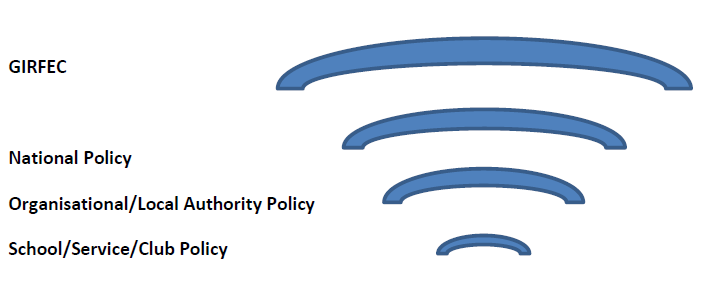
This is designed to illustrate the process and context for anti-bullying policies at every level and how we can ensure consistency in overarching values and principles from a Government level to an individual school or youth club level.


Brian


Parents and carers – responding to bullying

This blog contains some of the supporting advice we have given to parents and carers about how you actually respond to bullying – the processes we need to go through and to include children and young people going forward to help them regain a sense of control ands influence over their lives.

How do I know if it’s bullying?

When we talk about bullying we are talking about something that is both behaviour and impact. Behaviour that can make people feel hurt, frightened, scared, left out or worried – and the impact of this behaviour leaves them feeling less in control of themselves.

We know that bullying takes something away from people; that is one of the things that makes it different from other behaviours. It takes away people’s ability to feel in control of themselves and to take effective action.  We callthis our agency. Bullying strips away a person’s capacity for agency.

It’s important to remember this when we respond to bullying behaviour.  If we can accept that it takes something away from someone, our focus has to be on helping them to get it back; helping them get back that feeling of being in control and being themselves again. That’s why we have to involve young people in what they want to happen, what they would like to happen, and what they are worried about happening. 
And sometimes we need to take a lead from them as to what pace we go at. If we can do that, we can help restore that feeling of being in control. 

We are teaching children very important life skills.  We are teaching them to negotiate difficult relationships and that’s a factor of life for everyone.  It’s a skill we all need as adults, to learn how to get on with people and to learn how to dislike someone in a respectful manner.  That’s how we approach bullying.

What advice should I give?

Hearing that your child is being bullied brings out an understandably emotional response. It’s difficult for parents and carers to hear.  It’s difficult because you feel so strongly about it and when you hear your child is being bullied, you are not always at your best.

Sometimes the advice we give children and young people at this time isn’t necessarily the best advice. Being told to hit someone back if you are being bullied is actually a common response; children and young people have told us this is something they hear. We know it exists as an option to use but we know, by and large, it’s not necessarily the best or safest option to take.

It doesn’t take into account people that can’t or won’t hit back; people that have mobility problems or who are too scared, or people who won’t like the thought of violence.  So there always has to be an alternative to it. We don’t go through life answering challenges and relationship difficulties by resorting to violence, yet we tend to tell children if they are being bullied they should hit back – whether they are being physically bullied or bullied online, that’s the advice we tend to give.

There is never one, single, answer when it comes to bullying, it’s about knowing how to think about it and how to approach it.

Sometimes you have to ask your child, ‘what do you want to happen?’
‘tell me what you have done so far?’
‘what would you like me to do?’
‘what do you think would happen if, say, I was to go up to the school and talk to them about it?’.

If they are worried that you would make it worse, you might have to try something else because most children want bullying to stop with the minimum of fuss.
‘What do you think would happen if I spoke to someone’s mum?’ or
‘is there someone else you can talk to?’

It’s about exploring options; thinking about what you can do and sometimes having to say, as a parent, ‘look if I’m worried and I don’t think you’re safe, I’m going to step in’, and explain why you are doing it.

This process of exploring what you can both do role models a way of thinking and the aim is to agree a way forward – a plan you can agree to and agree to review if it’s not working. You will have a positive impact on their anxiety levels as they can discuss things with you and they can see your desire to help rather than you being angry or upset. It is not about as a parent or carer having all the answers – it is about asking each other questions, talking and most importantly listening, to get closer to an answer together.

Listening isn’t always easy – especially if we are emotional but the one thing children and young people have told me consistently over the years is that they want listened to when they are being bullied.

The temptation to run off and solve it is an understandable one, but we should always take a moment, pause and think, ‘how do I give my child back a sense of being in control?’ because it’s that sense of being in control that has been taken from them, and that has to focus your response. Sometimes your child might ask you not to do anything straight away – to give then the chance to go back into school and see how things are.
 

What if my child is bullying someone else?

If your child has been accused of bullying or you suspect your child is bullying, you have to address their behaviour and the impact that it has had. Children who are bullying others need help to repair relationships; they need help to understand that what they’ve done is wrong. Sometimes they know the impact of what their behaviour is; that’s why they’re doing it, but sometimes they need help to understand the effect their behaviour is having on someone else.

It’s important when we deal with children who are bullying that we don’t label them.  We talk about their behaviour and we talk about the impact that it has, we don’t label them as bullies. There isn’t any one stereotypical ‘bully’.  Bullying is behaviour that makes people feel a certain way – and many of us will have acted in a certain way that made someone feel hurt, frightened or left out. It’s much easier to change your behaviour if I say, ‘when you did that to him, that was bullying’. I’m much more likely to get a better response then if I say, ‘because you did that, you are a bully’.

People won’t recognise that label, parents will object to that label and you don’t change behaviour by labelling people. You change behaviour by telling people what they did, why it was wrong, and what you expect instead.

Prejudice-based Bullying and promoting equality

This is to give this some contect and to explore why we take the approach we do when creating environments where people feel safe and included and the challenges we face with this. We also explore what protected characteristics are and why they exist and how do our values affect how we challenge prejudice.

Probably the best place to start would be with prejudice – to ‘pre-judge’
Noun
1. An unfavourable opinion or feeling formed beforehand or without knowledge, thought, or reason.
2. Any preconceived opinion or feeling, either favourable or unfavourable.
 
So, everyone can be and is likely to have some prejudices – some things we have favourable views towards and some less so. When we act on this prejudice and treat people less favourably, we are discriminating.
Bullying, as has been covered in many of these blogs, is a mixture of behaviour and impact that affect a person’s capacity to feel in control of themselves. This is what we term as their sense of ‘agency’. Bullying takes place in the context of relationships; it is behaviour that can make people feel hurt, threatened, frightened and left out.
When this behaviour is motivated by prejudice, we are talking about prejudice-based bullying.
Prejudice will be based on a personal characteristic or a group that someone either belongs to or people believe they belong to or identify with.  So what might these characteristics be? Their gender?  Are they gay? Is it their religion? Do they have a disability? Or is it how they look or what they wear? It can be any of these and more.
So why are some personal characteristics mentioned more than others?
Some personal characteristics are protected within the law – the reason for this is to address the imbalance – to address the years of unfavourabletreatment experienced by some groups over the years
The experience of women, of LGBT people, of black people or of people with a disability, has shown that they have received less favourabletreatment in many ways over the years – in terms of being picked on, excluded and not having equal access to employment  and education. This was initially responded to through legislation such the Race Relations Act 1976, that ‘outlawed discrimination’ or the Equal Pay Act 1970, that was intended to address the less favourable treatment of women in the workplace. Legislation such as the Sex Discrimination Act 1975, was also intended to address discrimination on gender and married status. These Acts were needed specifically because of the imbalance and  the unfair treatment these groups were clearly receiving.
This has evolved and led to the Equality Act 2010 which is designed to protect people from discrimination in the workplace and the wider community such as in Education or as a consumer. This Act sets out that it is unlawful to discriminate against a person due to the following personal characteristics –
  • age


  • being or becoming a transsexual person


  • being married or in a civil partnership


  • being pregnant or having a child


  • disability


  • race including colour, nationality, ethnic or national origin


  • religion, belief or lack of religion/belief


  • sex


  • sexual orientation


Based on the historical prejudice and discrimination experienced by people who have these, or are perceived to have these characteristics, they now warrant special protection under the law to address the inequality they experienced. These characteristics are protected and as such are referred to as The Protected Characteristics. Age and being married do not apply in Education.
Public examples of this have been highlighted in the media such as cases where people who refuse a service like a hotel room to same sex couples or build new schools that are inaccessible to wheelchairs, will be in breach of the Equality Act.
I get asked a lot why red hair, wearing glasses or being tall or overweight isn’t a protected characteristic too, people experience bullying for these reasons also.  One of the most common reasons young people cite for bullying is personal appearance –that could be related to the music they like or the income of their parents.
The answer to this is that while people do get picked on and excluded for a variety of reasons, the groups protected under law have clear historical evidence of societal and cultural exclusion and less favourabletreatment. It may sound a little glib – but once all of the tall people get together and can reflect on and evidence years of collective exclusion, not getting work, missing out on promotion, being made to take only certain lessons at school like home economics, receiving abuse or suffering violence and intimidation on a collective basis ; then that too may become a legally protected characteristic.
This does not in any way mean that the bullying of a person because of the way they look is less serious or not as important as bullying based on a protected characteristic. The protected characteristics are not designed to create a hierarchy but to help address the imbalance experienced by certain groups. We know from our work that children and young people who are disabled, who are or are perceived to be LGB or T can experience bullying more frequently than other groups – this just means we need to be aware of and be able to challenge what values and prejudice lies behind this behaviour.
We also know that children and young people bully others because they don’t get on or they don’t like each other – we sometimes forget the interpersonal elements of bullying situations.
You might not like a person who is gay or a different faith from you but that is not the reason you dislike them – a person is cable of disliking someone and being mean about them without using a personal characteristic, protected or not, as the topic for their insult or behaviour. There is a difference between ‘I can’t stand him he is a pain and he talks rubbish’ and ‘I can’t stand him, he’s a black (insert whatever word/insult here)’.  The latter is a clear example of a prejudice-based statement based on someone’s race or ethnicity.
Research has shown us that where polices are explicit about what they mean by prejudice-based bullying, where we name specific behaviour they find unacceptable – adults and young people feel more confident to challenge these prejudices and behaviour .
Policies that don’t mention things like homophobia, disability, race or even socio economic status are linked to environments where adults are unsure about challenging certain behaviour and language. This explicit commitment to equality and challenging inequality is clearly linked to better practice in dealing with and preventing prejudiced-based bullying.
Schools, services or clubs that are clear that they will challenge homophobia, that they will challenge bullying based on disability, race or ethnicity, gender, sexual orientation, transgender status, religion and belief, socio economic status, appearance, if children are Looked After, are young carers or are refugees or their families are asylum seekers, will be creating environments that value difference and set out clear expectations about what behaviour is acceptable and what is not. Adults can then be held accountable to this as can children and young people.
This though presents a further challenge for the grown-ups. Are you confident to challenge prejudice? All prejudices or just the ones you object to? Confidently challenging some prejudice will be easy for many people – our own values and those of our chosen profession are compatible and we have the knowledge and passion to challenge and educate. Some of us need to get better informed on some areas – help is available form a range of agencies if you want to learn more about asylum seekers or migrants, about transgender people or a particular disability.
We normally learn more about things when we need to. When we are presented with behaviour or attitudes we don’t know much about, we go and find out about the issue to be better informed – the desire to do this is underpinned by values of fairness and equality. So what about the people whose personal values are perhaps not as ‘in-step’ as others?
You may well work or have worked beside someone who is misogynistic, who says racist things, is sectarian perhaps and this only appears on nights out or in the staff room or on social media.
I do find myself saying to colleagues that we are not the thought police – we cannot tell people what to think or that they are not allowed an opinion – what we can do is hold people accountable to the legal and ethical boundaries of their role or profession.  The reality is if a person is even a little prejudiced towards things like equal marriage, Syrian Refugees or women being as good as men at their job – this will be evident in how they challenge these prejudices.   If adults have these prejudices they will not effectively challenge behaviour because it conflicts with their values.
Our values underpin what we do and they will always make themselves evident – some people are good at telling you what their values are at interviews but not so good at showing these when they hear certain language.  They will say thing like ‘You are not allowed to say things like that here’or ‘someone might find that offensive’or actually say and do nothing because they agree with what is being said. When prejudiced language or bullying challenges your values – you will challenge it with passion and clarity, and people will believe you.
Inequality is a huge issue for society – we are addressing historical and cultural issues and responsibility for this rests with people at all levels – not just those who work with our children and young people.
We have had some high profile examples of this – the Ryanair passenger who racially abused a fellow passenger – his defence was that was not racist or when footballer John Terry racially abused a fellow player – his friends defence of him was that they knew him, and he wasn’t racist. I always respond the same way – maybe that’s not his ideology, that’s not what he is 24/7 but what he said was racist – and he is accountable for that. Not what he thinks he meant or feels on other occasions – what he said was wrong. 
So what can I do?
While these are huge cultural issues we can, as individuals and organisations, give children and young people a better experience, a different experience that values them, one that challenges inequality and involves them in setting the culture and ethos in places they go. When some of us talk about equality; we talk about treating everyone the same or the need to. For me, as a practitioner equality has always meant that I have a duty to challenge inequality.
The training I received helped me view my role as someone who is, for example, anti-racist – not simply ‘not racist’. I commit to challenging racism and racist language. I will challenge homophobia or practices that promote gender inequality and so on. This is what we can all do. On my shift, in my classroom, I will challenge prejudice and value individuals. The walls in our club or class, the activities we do, will clearly value diversity and we will learn about difference and respect. 
We won’t achieve this by starting off from a point where we treat everyone the same – our goal is to achieve equity first and we need to address the imbalance –


Creating environments such as these and role modelling how to challenge prejudice and promote what makes people different, and to learn to accept this, is exactly what we sign up for if we work with or even have children.
Brian