
Anti-Bullying Policy – a journey

Everyone’s favourite thing I know but developing an anti-bullying policy is a crucial step for us all – it is vital if we want to create environments where bullying cannot thrive. Environments where bullying does not thrive are known for the quality of the relationships on show, they are known for being inclusive and safe and  they listen. This does not happen by accident, there will be effective leaders in these places, valued staff, children and young people. There will be shared aims and an understanding of what it means to go there – to be a part of it.

Part of what builds a shared understanding and shared vision is that it is written down and explained, it is shared and understood. It sets the boundaries, ethical and professional, for how people are expected to relate to each other and allows us to hold each other accountable. Places where the tone and mood is set by one powerful individual can be effective but a top down approach which relies on unwritten rules, presents challenges for new faces as well as for those who may not be entirely in step.

I like to explain culture as ‘the way things are done here’.  I want my children to go to a school where they value difference, where they care about the pupils, where they role model good relationships and listen to the pupils. Not a culture based on fear or a domineering Head or a Unit Manager and their acolytes. I have worked in places like this and one of the only ways I could hold colleagues appointable and start to influence change was to include and reference what polices we were supposed to be operating within.
I know many roll their eyes at the thought of policy and, given some of what we have to read and assimilate at times, it’s an understandable response. When we are looking at responding to bullying and, crucially, creating an environment where bullying cannot thrive, we need a written commitment to how we should expect people to behave.

In places where the culture is ‘Well, we all know how to behave and we all know what bullying is’ I ask, ‘How do you know and are you sure everyone thinks the same way?’ In the absence of a written statement that states ‘this is what we mean by bullying here is how you should be treated’ people remain free to interpret behaviour themselves and decide if they feel a response is warranted.
We know from experience that this is way too subjective and people’s own values and prejudices influence this hugely. If you think bullying is ok and didn’t do you any harm, you won’t respond effectively, if you think being gay is wrong, you can’t actually respond effectively to homophobia. If you think online bullying is nothing to do with you then you won’t be able to help anyone deal with it when it is happening to them.  This is why we need  policies, they are not theanswer but they are a part of the answer.

Based on the work we have been doing at respectme for the last nine years, around developing and influencing policy, we have found effective ways to ensure policies are better understood; they are co-produced with stakeholders, especially with children and young people.There is no legal requirement in Scotland for schools to have an anti-bullying policy, but it is  good practice and those who regulate and inspect you will expect to see one.

But we know that employing a ‘scatter gun’ approach to policy development does not work, by this I mean working with any one school at a time. There is no evidence to suggest this is an effective way to improve practice across the country, instead we get very patchy and inconsistent anti-bullying practice.  At respectme we help develop policies at an organisational level, these are then cascaded locally to ensure a more consistent picture and a greater reach.

In Scotland we have a National Approach to Anti-Bullying, which sets out the Government’s expectations. A revised version of this will be launched  this year and it will be called ‘Respect for All’. respectme has influenced this a great deal and our experience of developing and implementing policy has been central to this. I will describe the rationale for the process first rather than just what you need to put in a policy.

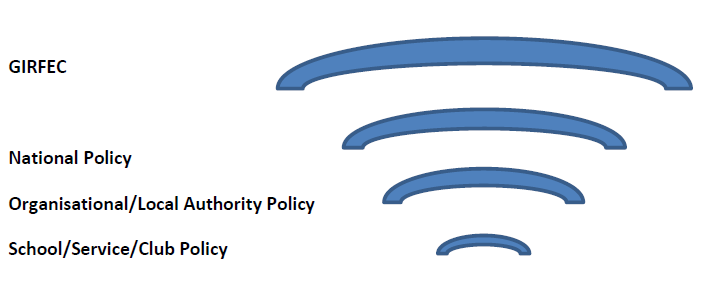
Our approach is to support organisations and local authorities to develop anti-bullying polices that are in step with the National Approach. This means they are underpinned by the same values of fairness, inclusion and equality, and there is a consistent definition of bullying and consistent guidance on what to do when bullying happens. It means that your local authority, school and sports club should have the same definition and use the same language when talking about and when you are challenging bullying.

The 2011 evaluation of respectme highlighted that adults and young people having a shared language and understanding on bullying was critical to success and in creating environments where bullying cannot thrive. respectme  helps an organisation or a local authority to develop a strategic overarching anti-bullying policy that is cascaded to each individual service, club or school within it.

We advise on and support a process of collaboration; getting the views of children and young people, parents, adult’s, staff and volunteers. This way the policy does not just appear out of the blue and it can be launched in the knowledge that the right people were asked and included.

Experience has also shown that the most effective way to integrate this into local practice, the most effective way to ensure individual schools, clubs or service have a good and well understood policy, is for them to take the organisational one and develop their own one locally.

This policy will be underpinned by the same values, definition and crucially it will mirror the process of collaborating with children and young people, parents and staff. This should lead to a shorter local policy that starts by referencing the organisational or local authority policy. This allows schools to say, ‘Glasgow City Council states.. and at Bellahouston Academy we do this…’ or ‘Aberdeen City Council sates… and at St Mary’s our pupil council said … about bullying.’ This is taking national policy and making it relevant locally. If every school just put a copy of the local authority policy on the shelf, there would be no ownership of it, no journey embarked upon where local issues and local parents got involved and this approach is far less likely to be successful.

This is not about doubling the workload but ensuring a very robust policy framework is in place to help those being bullied and to support those who are dealing with it. So in Scotland we would expect to see an individual school, service or club with an anti-bullying policy that is developed to reflect the organisational or local authority one. respectme will help ensure the local authority or organisational policy reflects the National Approach.

This means that in practice an individual badminton club, primary school or football club can have a policy that shares the values and principles of the organisation they are part of or that governs them. That organisation should have a policy that reflects the National Approach. This consistent language and framework should benefit children and young people, their parents and cares and those who work with them. Everyone gets the same message.

So when a parent asks for the schools policy, they should get the individual school policy but also see the local authority one, as this will give greater detail on what they can expect and what routes to take. It isn’t one or the other, best practice is both. If you are a local club not part of an organisation, you governing body, such a Sport Scotland will have a policy to reference, if you are even more local and not part of this set up, you should still use the National Approach as a guide for your policy – this will ensure it is in step with the policies the same children and young people will experience at school or other places.

All of this is designed to ensure that policy is more consistent at every level, local, organisational and strategic.

There are some things you need to put in you policy whether you are an organisation, a youth club  or a school and one of these is a commitment to challenging prejudice-based bullying. Every single policy must be explicit about the Equality Act 2010 and each of the protected characteristics.  This has been covered in other blogs on this site. We know from the research we did for the EHRC that where policies explicitly mention things like homophobia biphobia and transphobia, racism, gender-based prejudice etc.  staff feel more confident to respond to this type of behaviour when they see it. The policy gives them permission to challenge and discuss these issues and crucially, raises an expectation that they will challenge prejudice-based bullying.

There was also evidence to suggest that establishments where their policy does not mention specific types of prejudice-based bullying ,  practice is not as good and both staff and children and young people felt less confidence about dealing with this kind of bullying.

Policy is a journey, a values based journey to share understanding of what bullying is and what is expected of everyone involved what behaviour you can expect and how you can expect people to respond. It gives us a framework for anti-bullying practice and something we can and should be held accountable to.

So don’t be put off, get it right, make it inclusive and that in iself is a big part of developing environments where bullying cannot thrive, why would we not do that?
For more information on what goes in your policy, visits www.respectme.org.uk

This is designed to illustrate the process and context for anti-bullying policies at every level and how we can ensure consistency in overarching values and principles from a Government level to an individual school or youth club level.


Brian


Cyberbullying – a clearer focus

I felt it was time to update some of the advice and information I have previously shared about online bullying. – As  Safer Internet Day approaches there are many articles appearing online about ‘cyberbullying’ and conferences and events taking place, dedicated only to this type of bullying.

Bullying is behaviour that makes people feel frightened, hurt, threatened and left out. It impacts on a person’s ability to feel in control of themselves (their ‘agency’) and to respond effectively. This behaviour can harm physically and emotionally and the threat is typically sustained. This behaviour takes place in a variety of places, including online.

The research I undertook in late 2014 provided a picture of what types of behaviour children were experiencing and where it was taking place. The findings confirmed what many already thought while continuing to surprise many others.

Face to face bullying accounted for the majority of bullying incidents. The three most common behaviours experienced when being bullied face to face were:

Name calling

Hurtful Comments

Rumours

8,000 children and young people from across the country took part in the research. 30% of them said they had experienced bullying in the last 12 months. Of the incidents they experienced:

60% took place in person

21% took place both in person and online

19% tool place online only

They also told us that only 6% of bullying started online – and it was usually related to something that happened in school or face to face. The behaviour  can then continue online, face to face and sometimes both.

The three most common behaviour experienced online were:

                Name Calling

                Hurtful Comments

                Verbal Abuse

This shows that there is little difference between the behaviours experienced – only where they took place.

This has helped us work with colleagues to develop local surveys and questionnaires that ask the right questions, not ‘Were you bullied’ and ‘were you cyberbullied?’ But ask ‘Were you bullied?’ ‘What was the behaviour and where did this happen?’ Children and young people were able to tell us very clearly things like ‘I was called names and this happened on the bus and on Facebook’.

There should be little focus on where it took place – it was still bullying.

The findings from the research show that online bullying is more public and more visible. This is what contributes to the notion that it is a ‘bigger’ or ‘increasing’ problem. Bullying behaviour is not always seen by lots of people – threats and manipulative behaviour still takes place largely in private – away form everyone else.  This is still the most common type of bullying; sneaky, under the radar behaviour, carried out in places where there is little or no supervision.

So what are the risks with this?

The main risk is that we have, and often still do, focus heavily on online or cyber bullying and  have almost started to ignore the less public types of bullying.  I even get asked about what has happened to ‘traditional’ bullying. We seem to have developed this notion that the only thing to be concerned about is the stuff that happens online. This is not to say what is happening online isn’t concerning, of course it is, but so is the behaviour our children and young people continue to experience face to face – and sometimes both face to face and online.

We do not need to develop specific polices for online bullying, but we need to ensure that  all of our anti-bullying policies and practices reflect that things happen both face to face and online. This approach is in line with international research and best practice. When we talk about bullying we mean bullying that happens face to face and online.

When talking to children and young people recently about new national policy they told me they found it strange that people still talked about ‘cyber’ bullying as ‘cyber’ is just not a word they use for anything.  The distinction between online and offline isn’t as straightforward as some adults may think. Relationships play out online and in person – whether chatting face to face or  on Twitter or Snapchat – it’s all talking to friends.

Young people told us some very interesting things about their lives online. The majority of young people (81%) consider their online friends to be all or mostly the same as in real life. Only 4% of the 8,000 surveyed said they did not know the people they were ‘friends’ with online.

Crucially, 92% of children who experienced bullying online knew the person bullying them. This goes some way to challenge the ever present line that anonymity is one of the driving factors behind bullying online. Young people interact and socialise with an extended network of other people they are connected to through school, family communities and friendships as well as similar interests in music or sport.

They also use social media  to communicate –the purpose of using smart phones, consoles or laptops is primarily about staying in-touch with friends, something which is as important for young people today as it was 40 years ago. They have different means at their disposal but the principle is the same.

On of the challenges we still face is the belief that if something happens onlineit did not take place in school and the school or teacher cannot do anything about it. Our advice on this has been consistent – we respond to what happened to someone – not where it happened. If a child or young person decides to inform their teacher – they are investing in them as an adult they trust to help them – that last thing we should be doing is sending them away.

I was talking to a teacher about this earlier this week and she feels frustrated that an incident that happened at a swing park between two pupils in the same class is being ignored by some colleagues because of where it took place. The school here is in a great position to help resolve this – they don’t need to do all the work but could lead on helping the children they know feel safer or behave more respectfully. It is the same if it happens on Facebook. Respond to what happened not where or when. Respond to how someone feels – that way you can role model effective ways of dealing with relationship and interpersonal difficulties.

Bullying is also about relationships – not technology.  We must focus on equipping young people with the skills to conduct themselves online in a more respectful manner; the skills to manage their environments safely, and to develop their confidence and abilities to negotiate relationships and problems. This is built on promoting and developing resilience. But we also have to equip parents with the knowledge and understanding about how social media and the other places children and young people go online work; how to make them safe and, most importantly, how to talk to their children about using them. respectme offers free training for parents on this.

‘Cyberbullying’ is bullying; it is about relationships that are not healthy or being managed or role modelled well. It is behaviour done by someone to someone else, it is the ‘where’ this is taking place that is new. The behaviour appears to be migrating, as children spend more time online, the behaviour they have always exhibited and experienced goes with them.

Adult fear and anxiety  has long been the biggest hurdle in dealing with bullying online. It has had a very high media profile at times and it appears ’new’.  For parents or adults who do not use social media or connect with their friends using the internet, this can be a challenging and, at times, bewildering experience.

Lots of colleagues have said they are ‘technophobes’ or are not ‘tech savvy’ and have voiced how much they dislike Facebook or twitter. We have maintained that if you work with children and young people or if you are a parent or carer, that is no longer good enough. You need to know! For some that will require a real effort to spend time and utilise their relationships to learn. We cannot abdicate responsibility for this to software. We need to connect and learn about how young people use the internet and the phones or laptops they access it from.

Many adults have experience of managing risk when working with children and young people, and this is a new place for us to consider. We need to be as imaginative and creative with the internet as we have been in other places.

What is not bullying?

One other phenomenon that has emerged is the conflating of all online behaviours and risks under one heading. Sexting is not bullying, it is largely a consensual thing, part of adolescents exploring relationships and attraction. Forcing someone to take a naked picture of themself or part of their body naked is not bullying, it is abusive and coercive behaviour. Threatening someone to do something sexually is not bullying – it is sexually aggressive behaviour. Some guidance in the UK had stated that grabbing a girl’s chest or putting your hand up her skirt is a type of bullying.  We  do not agree with this.  That behaviour is a type of sexual assault. We must not dilute abusive behaviour. This is not an attempt to demonise children and young people, but to address the fact that if we dilute sexually aggressive behaviour we run the risk of normalising it. People are still of the opinion that ‘bullying is a normal part of growing up’ or ‘It’s just bullying’. This is why we work closely with colleagues who work in areas of violence against women and girls particularly, to make sure we give a consistent message that sexually aggressive behaviour is never acceptable and, while bullying and abusive behaviour can be linked, they are not the same thing.

There have been high profile examples of blackmail, extortion and threatening behaviour online that have been referred to in the media as cyberbullying.  We need to be clear about what we are talking about.  If someone is targeted, and forced to hand over money under the threat that someone will release pictures of them, they are being criminally extorted – not bullied. Using the term ‘cyberbullying’  to describe a host of other abusive behaviours only adds to the fear and confusion on how to respond.

As we move forward we must ensure that we focus on the fact that when we talk about bullying, we are talking about behaviour that happens online and face to face.

Brian

Prejudice-based Bullying and promoting equality

This is to give this some contect and to explore why we take the approach we do when creating environments where people feel safe and included and the challenges we face with this. We also explore what protected characteristics are and why they exist and how do our values affect how we challenge prejudice.

Probably the best place to start would be with prejudice – to ‘pre-judge’
Noun
1. An unfavourable opinion or feeling formed beforehand or without knowledge, thought, or reason.
2. Any preconceived opinion or feeling, either favourable or unfavourable.
 
So, everyone can be and is likely to have some prejudices – some things we have favourable views towards and some less so. When we act on this prejudice and treat people less favourably, we are discriminating.
Bullying, as has been covered in many of these blogs, is a mixture of behaviour and impact that affect a person’s capacity to feel in control of themselves. This is what we term as their sense of ‘agency’. Bullying takes place in the context of relationships; it is behaviour that can make people feel hurt, threatened, frightened and left out.
When this behaviour is motivated by prejudice, we are talking about prejudice-based bullying.
Prejudice will be based on a personal characteristic or a group that someone either belongs to or people believe they belong to or identify with.  So what might these characteristics be? Their gender?  Are they gay? Is it their religion? Do they have a disability? Or is it how they look or what they wear? It can be any of these and more.
So why are some personal characteristics mentioned more than others?
Some personal characteristics are protected within the law – the reason for this is to address the imbalance – to address the years of unfavourabletreatment experienced by some groups over the years
The experience of women, of LGBT people, of black people or of people with a disability, has shown that they have received less favourabletreatment in many ways over the years – in terms of being picked on, excluded and not having equal access to employment  and education. This was initially responded to through legislation such the Race Relations Act 1976, that ‘outlawed discrimination’ or the Equal Pay Act 1970, that was intended to address the less favourable treatment of women in the workplace. Legislation such as the Sex Discrimination Act 1975, was also intended to address discrimination on gender and married status. These Acts were needed specifically because of the imbalance and  the unfair treatment these groups were clearly receiving.
This has evolved and led to the Equality Act 2010 which is designed to protect people from discrimination in the workplace and the wider community such as in Education or as a consumer. This Act sets out that it is unlawful to discriminate against a person due to the following personal characteristics –
  • age


  • being or becoming a transsexual person


  • being married or in a civil partnership


  • being pregnant or having a child


  • disability


  • race including colour, nationality, ethnic or national origin


  • religion, belief or lack of religion/belief


  • sex


  • sexual orientation


Based on the historical prejudice and discrimination experienced by people who have these, or are perceived to have these characteristics, they now warrant special protection under the law to address the inequality they experienced. These characteristics are protected and as such are referred to as The Protected Characteristics. Age and being married do not apply in Education.
Public examples of this have been highlighted in the media such as cases where people who refuse a service like a hotel room to same sex couples or build new schools that are inaccessible to wheelchairs, will be in breach of the Equality Act.
I get asked a lot why red hair, wearing glasses or being tall or overweight isn’t a protected characteristic too, people experience bullying for these reasons also.  One of the most common reasons young people cite for bullying is personal appearance –that could be related to the music they like or the income of their parents.
The answer to this is that while people do get picked on and excluded for a variety of reasons, the groups protected under law have clear historical evidence of societal and cultural exclusion and less favourabletreatment. It may sound a little glib – but once all of the tall people get together and can reflect on and evidence years of collective exclusion, not getting work, missing out on promotion, being made to take only certain lessons at school like home economics, receiving abuse or suffering violence and intimidation on a collective basis ; then that too may become a legally protected characteristic.
This does not in any way mean that the bullying of a person because of the way they look is less serious or not as important as bullying based on a protected characteristic. The protected characteristics are not designed to create a hierarchy but to help address the imbalance experienced by certain groups. We know from our work that children and young people who are disabled, who are or are perceived to be LGB or T can experience bullying more frequently than other groups – this just means we need to be aware of and be able to challenge what values and prejudice lies behind this behaviour.
We also know that children and young people bully others because they don’t get on or they don’t like each other – we sometimes forget the interpersonal elements of bullying situations.
You might not like a person who is gay or a different faith from you but that is not the reason you dislike them – a person is cable of disliking someone and being mean about them without using a personal characteristic, protected or not, as the topic for their insult or behaviour. There is a difference between ‘I can’t stand him he is a pain and he talks rubbish’ and ‘I can’t stand him, he’s a black (insert whatever word/insult here)’.  The latter is a clear example of a prejudice-based statement based on someone’s race or ethnicity.
Research has shown us that where polices are explicit about what they mean by prejudice-based bullying, where we name specific behaviour they find unacceptable – adults and young people feel more confident to challenge these prejudices and behaviour .
Policies that don’t mention things like homophobia, disability, race or even socio economic status are linked to environments where adults are unsure about challenging certain behaviour and language. This explicit commitment to equality and challenging inequality is clearly linked to better practice in dealing with and preventing prejudiced-based bullying.
Schools, services or clubs that are clear that they will challenge homophobia, that they will challenge bullying based on disability, race or ethnicity, gender, sexual orientation, transgender status, religion and belief, socio economic status, appearance, if children are Looked After, are young carers or are refugees or their families are asylum seekers, will be creating environments that value difference and set out clear expectations about what behaviour is acceptable and what is not. Adults can then be held accountable to this as can children and young people.
This though presents a further challenge for the grown-ups. Are you confident to challenge prejudice? All prejudices or just the ones you object to? Confidently challenging some prejudice will be easy for many people – our own values and those of our chosen profession are compatible and we have the knowledge and passion to challenge and educate. Some of us need to get better informed on some areas – help is available form a range of agencies if you want to learn more about asylum seekers or migrants, about transgender people or a particular disability.
We normally learn more about things when we need to. When we are presented with behaviour or attitudes we don’t know much about, we go and find out about the issue to be better informed – the desire to do this is underpinned by values of fairness and equality. So what about the people whose personal values are perhaps not as ‘in-step’ as others?
You may well work or have worked beside someone who is misogynistic, who says racist things, is sectarian perhaps and this only appears on nights out or in the staff room or on social media.
I do find myself saying to colleagues that we are not the thought police – we cannot tell people what to think or that they are not allowed an opinion – what we can do is hold people accountable to the legal and ethical boundaries of their role or profession.  The reality is if a person is even a little prejudiced towards things like equal marriage, Syrian Refugees or women being as good as men at their job – this will be evident in how they challenge these prejudices.   If adults have these prejudices they will not effectively challenge behaviour because it conflicts with their values.
Our values underpin what we do and they will always make themselves evident – some people are good at telling you what their values are at interviews but not so good at showing these when they hear certain language.  They will say thing like ‘You are not allowed to say things like that here’or ‘someone might find that offensive’or actually say and do nothing because they agree with what is being said. When prejudiced language or bullying challenges your values – you will challenge it with passion and clarity, and people will believe you.
Inequality is a huge issue for society – we are addressing historical and cultural issues and responsibility for this rests with people at all levels – not just those who work with our children and young people.
We have had some high profile examples of this – the Ryanair passenger who racially abused a fellow passenger – his defence was that was not racist or when footballer John Terry racially abused a fellow player – his friends defence of him was that they knew him, and he wasn’t racist. I always respond the same way – maybe that’s not his ideology, that’s not what he is 24/7 but what he said was racist – and he is accountable for that. Not what he thinks he meant or feels on other occasions – what he said was wrong. 
So what can I do?
While these are huge cultural issues we can, as individuals and organisations, give children and young people a better experience, a different experience that values them, one that challenges inequality and involves them in setting the culture and ethos in places they go. When some of us talk about equality; we talk about treating everyone the same or the need to. For me, as a practitioner equality has always meant that I have a duty to challenge inequality.
The training I received helped me view my role as someone who is, for example, anti-racist – not simply ‘not racist’. I commit to challenging racism and racist language. I will challenge homophobia or practices that promote gender inequality and so on. This is what we can all do. On my shift, in my classroom, I will challenge prejudice and value individuals. The walls in our club or class, the activities we do, will clearly value diversity and we will learn about difference and respect. 
We won’t achieve this by starting off from a point where we treat everyone the same – our goal is to achieve equity first and we need to address the imbalance –


Creating environments such as these and role modelling how to challenge prejudice and promote what makes people different, and to learn to accept this, is exactly what we sign up for if we work with or even have children.
Brian


Gender is Everyone’s Agenda

 I have copied my opening speech from this weeks ‘Gender is Everyone’s Agenda Conference – some more thought son this event to follow

The name of this conference was chosen very deliberately – gender is everyone’s agenda


This title emerged as we began exploring the challenges young people face and looking at the work being done by the range of agencies – many you will see today – just how much of their lives can be affected by gender inequality


We start of the games or the clothes boys or girls are expected to wear or are marketed at parents, to name calling bullying, insults, stereotypes, to threats and fear and abuse because they don’t conform to what is seen as normal behaviour, or they don’t do what is expected of girls when a boy asks you out or wants your picture, to feeling safe being out, to being targeted online, being exploited or abused witnessing and experiencing domestic violence or being attacked in the street..


This spectrum is where some of us sit – a lot of us found that we play a small part on this huge spectrum or behaviours or issues – but there is no one monopoly position on them – neither in policy or practice – all of these issues and many more are underpinned by gender inequality – they all adversely affect girls more than boys.  


Aggression and violence towards girls whether online, in school, in relationships is a complex phenomenon – not a new one either – the pressure to conform to norms or to be sexually active or to do what your friends tell you boys or girls are supposed to do – or are supposed to respond to if their girlfriend or boyfriend texts or speaks to another person are challenges we have been facing for years and at times we have tried to focus on each part of the spectrum of behaviours or looked at what the media does and then blamed that


When you look then at what each of us is doing on our small parts of the spectrum are doing – you ask – are they being consistent? Does it add up? It many places it does but many of us share the same frustrations at trying to get communities and schools and funders to look up and see the bigger picture.


We first became involved and were the catalyst for the partnership forming that brings you todays conference – based on our one area of influence – bullying


The term sexual bullying was being used more and more often and was appearing in policy and was being used to describe all manner of behaviours from homophobia to sexual assault – we felt this ran the risk of diluting serious behaviour – forcing someone, threatening to do something sexual they do not want to, isn’t bullying it abuse. Putting your hand u a girls skirt is not bullying – it is assault – these examples did and still do exist in policy in parts of the UK.

I as noticed a change when we were presenting evidence to the parliament on cyberbullying and after I spoke 5 other agencies spoke about exploitation and child abuse online – these are very very serious issues that need real policy and legislative focus – but we felt the term ‘cyberbullying’ was becoming an umbrella term for all negative and abusive behaviour online. I felt that if parliament is looking for evidence on exploitation and abuse online – we shouldn’t be in the room.


These two challenging issues converged and we decided it was time to talk to colleagues who were working on these very serious very relevant issues – we could learn from them about the areas they work in ad we could share what we did –so that we knew what children could expect from Childline, what Zero Tolerance was talking about in schools about relationships and violence and they knew what the anti-bullying messages were, what LGBT Youth Scotland say about domestic violence and violence that is routed in people not meeting gender norms – this vital and rich work being done runs the risk of being done in isolation


We wanted to get people together and look for where we can develop a consistent message – in policy and on practice. Every one of us was dealing with behaviour and violence migrating to the online world too but when we peel it all back and look at what we do – we are responding to gender inequality – pictures of girls being shared and commented on around school is misogyny 2014 – boys simply have new means at their disposal to perpetuate the myths about relationships, norms and how we talk about boys and how we talk about girls.


So ourselves, LGBT Youth Scotland, police Scotland, Local Authority colleagues, the Mentors for Violence Programme, NSPCC Scotland, Edinburgh University, Zero tolerance and Rape Crisis Scotland formed a partnership –


This group has formed in response to a shared concern and common interest in addressing gender-based inequalities and sexual violence.   It sets out a partnership approach to lead and influence gender-related policy and practice, as it relates to children and young people in Scotland.   It aims to challenge accepted behaviour, attitudes and relationships, with the purpose of reducing sexual violence amongst young people, acknowledging that the status quo is no longer good enough.


When each of us responds to reports or is delivering our area of work – we now know more about what our colleagues are doing and when we address gender issues – we have a broader and more informed position for some young people the link form say gender based bullying to gender based violence is clear for others less so but in understanding what each of us can do on that spectrum or for some continuum of aggression and violence we hope that we can develop more effective responses as we share our learning our understanding and listen to each other.


I am very proud to be standing here today opening this conference – I am very proud that it is not a conference about online risks, there are plenty of them happening, or a conference just on violence, or bullying – but one that hopefully gets straight to the point –  and that is how these are affected by gender inequality – I want us to get the conversation right – not always focussing on our own bits bit ask – how can we change attitudes and behaviours about gender


I suppose for me an example is when we look at what happens when sexting goes horribly wrong – a very important area – and we spend time on reflecting on social media sites, smart phones and the challenges they present – when the issue is actually what motivated the boy involved what told him what  he was doing was okay – not how did he did it or where – but why.


That is what I mean about getting the conversation right.


Today is our attempt to articulate the problem – to explore some of the key issues and to share these with you and to listen to what you have to say


We have avoided the temptation to present you with speakers all do and for you to sit there and appreciate – although I am sure you will appreciate the small number we have for you today – but we wanted it to be an active day – where the workshops and the networking are the focus – so please enjoy the variety on show – use the time at lunch and breaks to go round the various stalls and make connections.


Finally a quick thanks to Our Funders today from The Scottish Government – both The Learning  Directorate and the Equalities Unit  – thank you for this and we hope you can see that today has been money very well spent.


Brian Donnelly

Gender based bullying and Sexual Violence

An issue that we at respectme  have talked about many times in recent years arose again this year.  Various events and media, coverage saw the term ‘Sexual Bullying’  being used to describe a lot of very concerning behaviour.  I first responded to this particular ‘umbrella term’ several years ago (2009) following an article in The TESS – this is the letter

Your article “Sex pest boys are not only targeting girls, but teachers too” (March 27) opens by referring to the practice of “sexual bullying”.

This term is being used increasingly across the country and it is important to give the view of respectme, Scotland’s anti-bullying service on this. We believe people need to be careful when using this term. Sexually aggressive behaviour should be seen as just that. While there may be elements of this conduct that could be seen as bullying based on gender, what you described is sexually aggressive and inappropriate.

Using the term “sexual bullying” may well dilute sexually-aggressive behaviour or harassment to the status of “just another type of bullying” and, sadly, we know not everyone takes bullying seriously.

The converse side is that it elevates bullying to the same status as sexual harassment and sexual assault, which is not always the case.

We know the solutions to these behaviours can be very different. We must ensure that our children and young people understand that sexually aggressive behaviour and bullying are completely unacceptable, and that the consequences of taking part in either can be serious – without confusing the two.

This was discussed by the then Scottish Anti-Bullying Steering Group and it was agreed that this was the approach we would take in Scotland. Colleagues in LGBT Youth Scotland also felt to include Homophobia under the term ‘sexual bullying’ was reductive; being gay or lesbian is not about ‘sex’. Guidance from other parts of the UK includes homophobia on almost every occasion they define ‘sexual bullying’.

I have also read in another piece of guidance that a boy putting his hands up a girl’s skirt and touching her can also be sexual bullying, I am of the opinion this is in fact a sexual assault.

Some other organisations have given us even more concerning definitions that state, and I quote, ‘Sexual bullying in its most extreme form can be sexual assault or rape’.(Bullying.co.uk)

I strongly believe that this is an unhelpful and potentially dangerous road to go down. Bullying and rape is not the same thing. If we are looking for schools to discuss rape and sexual assault and sexual abuse under the umbrella of anti-bullying we run the risk of diluting this very serious behaviour.

Rapists are not bullying their victims, they rape them and they abuse them. Predatory males do not bully children they manipulate and abuse them – framing this abuse as bullying is, as I stated, reductive.

The Daily Telegraph also informed us this year that ‘15 children a day are excluded from school for sexual bullying’ – now while the behaviours described are concerning and rightly need to be addressed, 15 pupils a day were excluded for a range of behaviours including, lewd behaviour, sexual abuse, assault, bullying, daubing sexual graffiti, and sexual harassment. This also includes ‘sexting’, behaviour which is largely consensual but can and does spiral out of control. I suppose a headline informing parents that 15 children a day are excluded for a range of inappropriate sexualised behaviour isn’t quite as snappy.

Gender-based bullying and gender-based violence is a real problem for our children and young people. Children are bullied because they do not conform to gender norms, because they don’t dress the way others feel that’s how boys or girls should dress. Or that they are or are perceived to be gay or lesbian, this is still about gender, identity and norms. Or sadly, they believe that as males, they can treat the women in their life as objects and with a lack of respect.

Many of these behaviours can lead to violence and abuse – it can be a pattern that escalates, it can lead to manipulation and control, something many girls especially experience.

I have shared this thinking with colleagues from a range of services, from The Violence Reduction Unit, The Police, LGBT Youth Scotland, Zero Tolerance, NSPCC and Local Authorities and we plan to take this forward in the coming months and find a coherent and consistent way of talking about gender based-bullying and its links to violence and abuse.

None of us feel ‘sexual bullying’ is an accurate or helpful term but want to ensure we highlight the work being done and the work that needs to be done on gender roles, gender based violence, domestic violence and on sexually aggressive behaviour. If we lump all of this behaviour together we may find it harder to find solutions and things can become blurred as a result. This is not to minimise the link but the language we choose is very important. We need to be clear what behaviour we are talking about and not try to find catch all terms that may be convenient or media friendly.  

There is, I believe, a link between gender based bullying and sexual violence and that we should look to intervene effectively with gender based bullying as it may reduce the risk of violence. When I was delivering training in Austria last month, the delegates included several therapists and social work staff who work with the victims of sexual abuse. They found the term ‘sexual bullying’ very confusing – it would not occur to them to equate or talk about gender based bullying and sexual abuse or assault in the same way.

The day we start to think about rape or sexual assault as a type of bullying is a day when we will have really lost our focus. These are violent crimes and should be viewed as such – bullying is about relationships, relationships that are not respectful and anti-bullying work can help reduce the impact of this and help repair relationships and build respect. Can anti-bullying work underpin approaches and support work on sexual violence? I believe it can. Is sexual assault and sexual violence bullying? Absolutely not, it is much more serious than that.

 Brian

Brian Donnelly