
Bullying & Agency. How we can actually respond to bullying

I will not be starting this by offering my definition of bullying, it is only once we explore agency will the definition be worth sharing.

It is vital that we understand that bullying is both behaviour and impact –never always one and not the other. It is itself a relationship between certain behaviours and particular type of impact.

Bullying is not defined by persistence or intent. This is relevant because if you were to look up definitions online and in peer reviewed articles, the vast majority of these will refer to bullying as persistent and deliberate behaviour.

I would argue that these are unhelpful criteria to apply to situations. So much time can be lost trying to apply all the various factors, many of which are entirely subjective.

Let’s look at intent – if you tell me bullying must be deliberate and then accuse me of bullying, what is my first response? – That I didn’t mean it. Intent is difficult to prove. It can tie situation up in knots and the focus on responding to what someone did and the impact it had is lost.

Schools can waste a lot of time trying to prove intent –I have been involved in examples when intent is denied the adults are stumped.

It’s usually deliberate not always – sometime children use language they hear at home and have no idea of how offensive or inappropriate it is. We should not get caught up in using this as qualifying criteria though – it’s too easily re-framed

Let us now consider persistence – that the behaviour must be repeated before it can be considered bullying – again this is something I do not agree with and neither do most young people have I spoken to. Persistence is difficult to define and also, who defines when it’s persistent enough? Me, the person it is happening to or the intervening adult? Something need only happen once and the impact can be severe; a child may not get on the bus in the morning again or get changed for PE after this.

The fear of repetition can be sustained through looks or perhaps threats or just the fear of it happening again.

These two factors are present in the majority of definitions of bullying across the globe; both of which, we feel here in Scotland are unhelpful. What you do about bullying is actually more important than how you define it.

The questions we need to ask are;

What was the behaviour?

What impact did it have?

What do I need to do about it?

Every situation is unique. You might over hear some name calling in the corridor and discover this is chat between to close friends who are ‘winding’ each other up; it is not part of any power or dominance game.

What was the behaviour? Name calling

What impact did it have? None – made them laugh

What do I need to do about it? Nothing – perhaps remind them about language or being overheard

You may hear the same name calling ten feet further on but the person on the receiving end is upset and embarrassed in front of her peers.

What was the behaviour? Name calling

What impact did it have? Left someone embarrassed and fearful – who ran off

What do I need to do about it? Help this person get back into her routine, listen to how she feels and decide on next steps – you will need to challenge the people who called her names and look at possible consequences too

This does not mean we only focus on the impact behaviour has – this means that if someone shouts a homophobic or racist slur at someone and it bounces off them and they don’t care –this does not mean you do not need to do anything about the language used and the attempt to bully or dominate.

Just as not all attempts to bully are successful, people can feel bullied but not be – it is possible some people over react –you still need to deal with their reaction and their feelings but you might not need to do much about the behaviour – A useful workplace analogy might be a boss saying something as simple as – ‘you’re a bit late today’ and the staff member over-reacts and assumes this is an attempt to exert power and control and may then claim they are feeling bullied. They may panic, become restless, loose sleep and this will have an impact on them but the boss’ behaviour was perfectly legitimate and reasonable. This person needs help to work through their response but they have not been bullied.
So when we look at impact – things like feeling hurt, angry, scared, frightened, that knot in your stomach- what is happening there? What do these reactions say to us?
Young people reflect in a range of ways that they feel unable to speak out and feel trapped – they draw pictures of themselves in large rooms feeling caged and so on. This learning helped us articulate the notion that bullying actually takes something away from people.

All of these feelings which are regularly articulated reflect a loss of being in-charge of yourself, of being capable of taking effective action, of making choices and of being an effective actor or agent in your own life.
This is where agency came into our thinking. Lister calls agents ‘autonomous, purposeful actors, capable of a degree of choice’
Giddens talks about how we have agency within structures and our agency is utilised when we consciously alter our place in the structure’
Young people get this notion – as it can be a bit if a head scratcher the first time you hear it – though when you explain a ‘typical day’ of meeting friends, going to school, laughing, joining in and knowing what is happening and how you’ll respond. Bullied children don’t feel that. Someone else is in charge of how they feel, where they go even or how they will participate.

The ‘structures’ this dynamic takes place in is schools and communities. When they can exercise choice in what happens in these ‘structures’, they are utilising their agency.

The ability to negotiate relationships and difficulties is something all children and young people need to learn and develop – it is a life skill many adults still don’t always get right

We learn from our past experiences, from imagining what we would do in future similar situations and what is happening to us now – these elements combine and enable us to make choices and act – this is agency.
Managing change and responding to challenges requires hope, a belief you can handle things – and agency and these underpin resilience.
Bullying is not about just any kind of injury, nor just any negative impact. It involves a particular kind of harm. It is aimed at engendering a kind of helplessness, an inability to act, to do anything. It is an assault on a person’s agency (Sercombe and Donnelly 2012)
It is not even the establishment of dominance. The person bullying is not satisfied with dominance. Bullying involves the attempt to deny another any settled place, even a subordinate one. It goes beyond subjection. In bullying, the goal is abjection

Considering that bullying is both different types of behaviour and a particular impact that re-focusses our understanding of the dynamic – this can re-define bullying in a way that helps practitioners’ responsd to feelings and actions. This is always more effective than checking off criteria and having uniform sanction based responses.
Bullying is not defined by the type of person who did it either. Care needs to be taken because labelling is not without its risks, labelling a child or young person on the basis of bullying behaviour can result in a confirmed identity as a ‘bully’ or ‘victim’ resulting in ongoing behaviour patterns based on this identity.

This is not to dilute behaviour but is to keep the focus of the adult’s responses on the behaviour that is problematic, rather than the assigning characteristics to those involved. This is a solution focussed approach that is designed to help people change the way they behave, rather than attempt to change who they are. We help people change by telling them and naming the behaviour that is unacceptable, being clear that what they are doing is bullying and that it needs to stop.

It is a fundamental part of behaviour management that we tell people what the behaviour was they did, why it is not acceptable and help them figure out what to do the next time they feel that way – I did get asked recently if not labelling children as ‘bullies’ is gobbledygook at parliament

With this in mind – we offer up a new definition for people to consider

Bullying is a relationship of violence involving practices of domination that strip another person of the capacity for agency, using interventions carrying the sustained threat of harm.(Sercombe and Donnelly 2012)

The actual intervention may not be repeated, but the threat at least needs to be sustained over time. Typically, the threat will be sustained by actions: looks, messages, confrontations or physical interventions.

Lastly, if we can accept that bullying takes something away from people, that they can no longer take effective action our response must focus on helping get that back.

This is the real shift in anti-bullying practice – how do I help someone get back a feeling of being in control of themselves and in a place to take effective action to feel safe and get on with their day?

Things like moving desks or even just excluding people won’t on their own help restore agency – young people must be included in what will happen next and given the chance to steer what direction it goes in. They need to be asked what they would like to happen and we need to take that seriously.

This is not always easy but it must remain our goal with every intervention – to help young people get back to a place where they are in control and can take effective action. Where not all attempts to bully are successful – this can see you continue to challenge people’s behaviour but you may need a lighter response to the young people they are attempting to unsettle.

In reality – what does that look like? What does it sound like? You will need to ask questions like

What would you like to happen?

What do you think will happen if I tell his or her parents?

What will happen if I tell your teacher?

What are you worried about?

Be prepared for them to say

Don’t tell my dad – you will out me to him and I’m not ready for that

I just want you to know what is happening and if I need you I will come and get you

If you talk to his dad he will get a doing/beating and it’ll get worse
So you explore what options they do have and sometimes that means pointing out that you need to do something as not doing anything is dangerous
Open conversations like these promote communication – this promotes positive relationships and they promote and role model problem solving behaviours –these relationships can become stronger and children become more resilient to what is happening because of this strong purposeful relationship – even with just one person.

The process of listening and consciously trying to get back agency – a sense of being on control – won’t always lead to a perfect outcome but it will help the person being bullied
So in conclusion, I would suggest that we have in fact re-framed our approach to and understanding of bullying based on children and young people’s experiences – that this understanding compliments the significant and long standing work on resilience, and on how we promote and enable this in our children and young people.

When we are promoting respectful relationships, when we are building capacity to respond effectively, when we are helping young people learn to negotiate tricky relationships and when involve them we help them to become more resilient.

Brian
Anti-Bullying Policy – a journey

Everyone’s favourite thing I know but developing an anti-bullying policy is a crucial step for us all – it is vital if we want to create environments where bullying cannot thrive. Environments where bullying does not thrive are known for the quality of the relationships on show, they are known for being inclusive and safe and  they listen. This does not happen by accident, there will be effective leaders in these places, valued staff, children and young people. There will be shared aims and an understanding of what it means to go there – to be a part of it.

Part of what builds a shared understanding and shared vision is that it is written down and explained, it is shared and understood. It sets the boundaries, ethical and professional, for how people are expected to relate to each other and allows us to hold each other accountable. Places where the tone and mood is set by one powerful individual can be effective but a top down approach which relies on unwritten rules, presents challenges for new faces as well as for those who may not be entirely in step.

I like to explain culture as ‘the way things are done here’.  I want my children to go to a school where they value difference, where they care about the pupils, where they role model good relationships and listen to the pupils. Not a culture based on fear or a domineering Head or a Unit Manager and their acolytes. I have worked in places like this and one of the only ways I could hold colleagues appointable and start to influence change was to include and reference what polices we were supposed to be operating within.
I know many roll their eyes at the thought of policy and, given some of what we have to read and assimilate at times, it’s an understandable response. When we are looking at responding to bullying and, crucially, creating an environment where bullying cannot thrive, we need a written commitment to how we should expect people to behave.

In places where the culture is ‘Well, we all know how to behave and we all know what bullying is’ I ask, ‘How do you know and are you sure everyone thinks the same way?’ In the absence of a written statement that states ‘this is what we mean by bullying here is how you should be treated’ people remain free to interpret behaviour themselves and decide if they feel a response is warranted.
We know from experience that this is way too subjective and people’s own values and prejudices influence this hugely. If you think bullying is ok and didn’t do you any harm, you won’t respond effectively, if you think being gay is wrong, you can’t actually respond effectively to homophobia. If you think online bullying is nothing to do with you then you won’t be able to help anyone deal with it when it is happening to them.  This is why we need  policies, they are not theanswer but they are a part of the answer.

Based on the work we have been doing at respectme for the last nine years, around developing and influencing policy, we have found effective ways to ensure policies are better understood; they are co-produced with stakeholders, especially with children and young people.There is no legal requirement in Scotland for schools to have an anti-bullying policy, but it is  good practice and those who regulate and inspect you will expect to see one.

But we know that employing a ‘scatter gun’ approach to policy development does not work, by this I mean working with any one school at a time. There is no evidence to suggest this is an effective way to improve practice across the country, instead we get very patchy and inconsistent anti-bullying practice.  At respectme we help develop policies at an organisational level, these are then cascaded locally to ensure a more consistent picture and a greater reach.

In Scotland we have a National Approach to Anti-Bullying, which sets out the Government’s expectations. A revised version of this will be launched  this year and it will be called ‘Respect for All’. respectme has influenced this a great deal and our experience of developing and implementing policy has been central to this. I will describe the rationale for the process first rather than just what you need to put in a policy.

Our approach is to support organisations and local authorities to develop anti-bullying polices that are in step with the National Approach. This means they are underpinned by the same values of fairness, inclusion and equality, and there is a consistent definition of bullying and consistent guidance on what to do when bullying happens. It means that your local authority, school and sports club should have the same definition and use the same language when talking about and when you are challenging bullying.

The 2011 evaluation of respectme highlighted that adults and young people having a shared language and understanding on bullying was critical to success and in creating environments where bullying cannot thrive. respectme  helps an organisation or a local authority to develop a strategic overarching anti-bullying policy that is cascaded to each individual service, club or school within it.

We advise on and support a process of collaboration; getting the views of children and young people, parents, adult’s, staff and volunteers. This way the policy does not just appear out of the blue and it can be launched in the knowledge that the right people were asked and included.

Experience has also shown that the most effective way to integrate this into local practice, the most effective way to ensure individual schools, clubs or service have a good and well understood policy, is for them to take the organisational one and develop their own one locally.

This policy will be underpinned by the same values, definition and crucially it will mirror the process of collaborating with children and young people, parents and staff. This should lead to a shorter local policy that starts by referencing the organisational or local authority policy. This allows schools to say, ‘Glasgow City Council states.. and at Bellahouston Academy we do this…’ or ‘Aberdeen City Council sates… and at St Mary’s our pupil council said … about bullying.’ This is taking national policy and making it relevant locally. If every school just put a copy of the local authority policy on the shelf, there would be no ownership of it, no journey embarked upon where local issues and local parents got involved and this approach is far less likely to be successful.

This is not about doubling the workload but ensuring a very robust policy framework is in place to help those being bullied and to support those who are dealing with it. So in Scotland we would expect to see an individual school, service or club with an anti-bullying policy that is developed to reflect the organisational or local authority one. respectme will help ensure the local authority or organisational policy reflects the National Approach.

This means that in practice an individual badminton club, primary school or football club can have a policy that shares the values and principles of the organisation they are part of or that governs them. That organisation should have a policy that reflects the National Approach. This consistent language and framework should benefit children and young people, their parents and cares and those who work with them. Everyone gets the same message.

So when a parent asks for the schools policy, they should get the individual school policy but also see the local authority one, as this will give greater detail on what they can expect and what routes to take. It isn’t one or the other, best practice is both. If you are a local club not part of an organisation, you governing body, such a Sport Scotland will have a policy to reference, if you are even more local and not part of this set up, you should still use the National Approach as a guide for your policy – this will ensure it is in step with the policies the same children and young people will experience at school or other places.

All of this is designed to ensure that policy is more consistent at every level, local, organisational and strategic.

There are some things you need to put in you policy whether you are an organisation, a youth club  or a school and one of these is a commitment to challenging prejudice-based bullying. Every single policy must be explicit about the Equality Act 2010 and each of the protected characteristics.  This has been covered in other blogs on this site. We know from the research we did for the EHRC that where policies explicitly mention things like homophobia biphobia and transphobia, racism, gender-based prejudice etc.  staff feel more confident to respond to this type of behaviour when they see it. The policy gives them permission to challenge and discuss these issues and crucially, raises an expectation that they will challenge prejudice-based bullying.

There was also evidence to suggest that establishments where their policy does not mention specific types of prejudice-based bullying ,  practice is not as good and both staff and children and young people felt less confidence about dealing with this kind of bullying.

Policy is a journey, a values based journey to share understanding of what bullying is and what is expected of everyone involved what behaviour you can expect and how you can expect people to respond. It gives us a framework for anti-bullying practice and something we can and should be held accountable to.

So don’t be put off, get it right, make it inclusive and that in iself is a big part of developing environments where bullying cannot thrive, why would we not do that?

For more information on what goes in your policy, visits www.respectme.org.uk

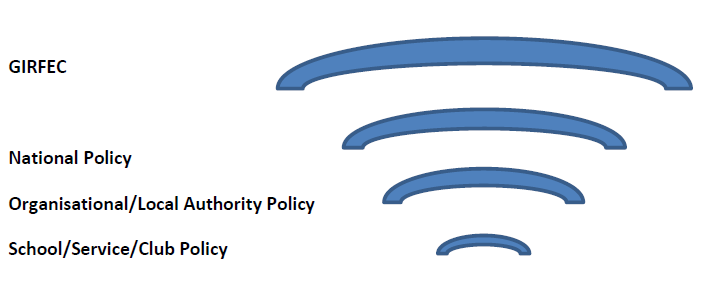
This is designed to illustrate the process and context for anti-bullying policies at every level and how we can ensure consistency in overarching values and principles from a Government level to an individual school or youth club level.


Brian


Parents and carers – responding to bullying

This blog contains some of the supporting advice we have given to parents and carers about how you actually respond to bullying – the processes we need to go through and to include children and young people going forward to help them regain a sense of control ands influence over their lives.

How do I know if it’s bullying?

When we talk about bullying we are talking about something that is both behaviour and impact. Behaviour that can make people feel hurt, frightened, scared, left out or worried – and the impact of this behaviour leaves them feeling less in control of themselves.

We know that bullying takes something away from people; that is one of the things that makes it different from other behaviours. It takes away people’s ability to feel in control of themselves and to take effective action.  We callthis our agency. Bullying strips away a person’s capacity for agency.

It’s important to remember this when we respond to bullying behaviour.  If we can accept that it takes something away from someone, our focus has to be on helping them to get it back; helping them get back that feeling of being in control and being themselves again. That’s why we have to involve young people in what they want to happen, what they would like to happen, and what they are worried about happening. 
And sometimes we need to take a lead from them as to what pace we go at. If we can do that, we can help restore that feeling of being in control. 

We are teaching children very important life skills.  We are teaching them to negotiate difficult relationships and that’s a factor of life for everyone.  It’s a skill we all need as adults, to learn how to get on with people and to learn how to dislike someone in a respectful manner.  That’s how we approach bullying.

What advice should I give?

Hearing that your child is being bullied brings out an understandably emotional response. It’s difficult for parents and carers to hear.  It’s difficult because you feel so strongly about it and when you hear your child is being bullied, you are not always at your best.

Sometimes the advice we give children and young people at this time isn’t necessarily the best advice. Being told to hit someone back if you are being bullied is actually a common response; children and young people have told us this is something they hear. We know it exists as an option to use but we know, by and large, it’s not necessarily the best or safest option to take.

It doesn’t take into account people that can’t or won’t hit back; people that have mobility problems or who are too scared, or people who won’t like the thought of violence.  So there always has to be an alternative to it. We don’t go through life answering challenges and relationship difficulties by resorting to violence, yet we tend to tell children if they are being bullied they should hit back – whether they are being physically bullied or bullied online, that’s the advice we tend to give.

There is never one, single, answer when it comes to bullying, it’s about knowing how to think about it and how to approach it.

Sometimes you have to ask your child, ‘what do you want to happen?’
‘tell me what you have done so far?’
‘what would you like me to do?’
‘what do you think would happen if, say, I was to go up to the school and talk to them about it?’.

If they are worried that you would make it worse, you might have to try something else because most children want bullying to stop with the minimum of fuss.
‘What do you think would happen if I spoke to someone’s mum?’ or
‘is there someone else you can talk to?’

It’s about exploring options; thinking about what you can do and sometimes having to say, as a parent, ‘look if I’m worried and I don’t think you’re safe, I’m going to step in’, and explain why you are doing it.

This process of exploring what you can both do role models a way of thinking and the aim is to agree a way forward – a plan you can agree to and agree to review if it’s not working. You will have a positive impact on their anxiety levels as they can discuss things with you and they can see your desire to help rather than you being angry or upset. It is not about as a parent or carer having all the answers – it is about asking each other questions, talking and most importantly listening, to get closer to an answer together.

Listening isn’t always easy – especially if we are emotional but the one thing children and young people have told me consistently over the years is that they want listened to when they are being bullied.

The temptation to run off and solve it is an understandable one, but we should always take a moment, pause and think, ‘how do I give my child back a sense of being in control?’ because it’s that sense of being in control that has been taken from them, and that has to focus your response. Sometimes your child might ask you not to do anything straight away – to give then the chance to go back into school and see how things are.
 

What if my child is bullying someone else?

If your child has been accused of bullying or you suspect your child is bullying, you have to address their behaviour and the impact that it has had. Children who are bullying others need help to repair relationships; they need help to understand that what they’ve done is wrong. Sometimes they know the impact of what their behaviour is; that’s why they’re doing it, but sometimes they need help to understand the effect their behaviour is having on someone else.

It’s important when we deal with children who are bullying that we don’t label them.  We talk about their behaviour and we talk about the impact that it has, we don’t label them as bullies. There isn’t any one stereotypical ‘bully’.  Bullying is behaviour that makes people feel a certain way – and many of us will have acted in a certain way that made someone feel hurt, frightened or left out. It’s much easier to change your behaviour if I say, ‘when you did that to him, that was bullying’. I’m much more likely to get a better response then if I say, ‘because you did that, you are a bully’.

People won’t recognise that label, parents will object to that label and you don’t change behaviour by labelling people. You change behaviour by telling people what they did, why it was wrong, and what you expect instead.

Bullying in Scotland 2014 Reserch Survey Findings

I have posted a brief summary of the results of a survey carried out earlier this year – I will be posting a lengthier blog in the not too distant future  discussing the findings in greater depth but for now at least – here is a quick snapshot of what children and young people told us

The research

The primary aim of this piece of research was to obtain a picture of how children and young people are experiencing bullying in Scotland in 2014.

This research was designed to:

·         Identify the types of bullying that is experienced by children and young people.

·         Give a clear picture of where bullying happens and where online and offline/face to face experiences differ or crossover.

·         Identify from children and young people’s own experience what they feel works and what is less helpful.

·         Identify where children and young people go online and what technology they use to get there.


An online questionnaire was designed and tested and distributed to all schools in Scotland in May and June 2014. In total, there were 8310 responses, of which 7839 were useable. Responses came from all over Scotland with all 32 Local Authorities represented. Respondents were aged between 8 and 19 years old. Sixty five per cent were 12 – 14 years old.

This was an open survey and the findings presented here represent only the views of the children who took part.

Three focus groups took place with 45 young people to get a more detailed insight into children and young people’s experiences of bullying – in particular, their thoughts on what happens online and in person, where these two are different and where they crossover.

Key findings


The key findings from the survey are as follows:

  • 30% of children and young people surveyed reported that they have experienced some sort of bullying behaviour between the start of school in August 2013 and June 2014. Of this 30%:

§  49% experienced bullying in person

§  41% experienced bullying both in person and online

§  10% experienced bullying online only.


  • A number of children and young people had more than one experience of bullying. Children and young people surveyed reflected 12,003 experiences of bullying behaviours. Of these experiences: –

§  60% took place in person

§  21% took place both in person and online

§  19% took place online only


  • 92% of children and young people who were bullied knew the person bullying them (91% online and 92% offline). Anonymity therefore may not be what is driving bullying online.

·         Behaviours such as name calling, hurtful comments and spreading rumours that make people feel angry, sad and upset happen both face to face and online.

·         Children and Young people employ a range of strategies to cope with bullying; some are more successful than others.

§  Almost half (48%) of children and young people who are bullied tell their parents.

§  Friends and teachers are also providing support to a high number of children and young people who are bullied.

·         The most successful anti-bullying interventions are embedded within a positive ethos and culture and don’t just focus on individual incidents.

  • Children and young people’s use of technology, especially mobile technology and social media, is woven into their everyday lives.
  • The majority of children and young people (81%) consider their online friends to be all or mostly the same friends they have in real life
  • Children and young people access internet content on mobile devices, such as phones and tablets, more than other devices such as  PC’s or laptops.
  • Google, YouTube, Snapchat, Instagram and Facebook are the most popular websites and Apps used by children and young people when they go online.


  Next Steps


We will further analyse the data we have collected and use it to help develop effective policy and practice around bullying. The data is likely to help us to address some questions more effectively including: –

·         Given the relatively low proportion of exclusively online bullying, and the similarity of online and offline bullying behaviour, to what extent is a specific response to online bullying needed?

·         What are the appropriate responses to gender specific differences in experiences of bullying?

·         How can we help schools to further develop an anti-bullying ethos? And how can we continue to ensure children and young people are involved and included in this process?

·         How can we continue to support parents to respond when their children tell them about being bullied?

·         How can schools further help children and young people learn from other pupils about the strategies that they have found useful?


Cyberbullying – anonymity and other challenges for parents

Sadly the last few days have seen an increase in media enquiries and media activity across the UK about bullying and online bullying, following the tragic suicide of Hannah Smith. We have contributed to this as best we can at respectme; sharing our understanding, our approach to anti-bullying and our resources wherever we can.

I have written before on this blog about online bullying and have attached copies of a briefing we’ve developed around this. Both have been well read and shared across the world. I do feel though that it is relevant to share some thinking on what has been happening recently, and specifically about anonymity online and websites like Ask.FM and our reaction to them.

Some of the behaviour we have been reading about in the media from young people towards their peers is very concerning; it can be cruel, hurtful and read by hundreds of others across the world in a short space of time. And yet, young people still want to be involved in these online social spaces. 

Social websites that get demonised in the press develop a reputation, and the behaviour of those who take part in these sites may well reflect this.  But behaviour will be erratic and, in time, may settle down and be more self-regulated.  If sites can show that their code of conduct is implemented then behaviour is more likely to fall into line with this – if abusive and hateful comments disappear and users leave or change – it becomes evident to users that there are boundaries on this particular site.

Of course people who provide on-line platforms must do so responsibly.  They must create environments that are safe, where it is easy to report abusive behaviour – just as we would expect of anyone providing any other social space to children and young people! Whether it is a drop-in centre or a social networking site – have they assessed the risks and what have they done to minimise them?

The issue of anonymity has been central to many discussions and concerns about Ask.FM in particular. Anonymity does provide cover for people to act in a way they may not do if they had to use their own name – but not always – there is no shortage of abusive posts online and the name and face of the person doing this is very public!

It should be noted though that users can go into their privacy settings in Ask.Fm and change them to disable anonymous questions, so the possibility to remove anonymous posts on your page exists, yet few young people choose this option. Even fewer parents are aware it exists. Perhaps it should be the default setting, but default settings are mainly still based on what gives those who design and manage sites the most useful information to sell stuff to you – not to make sure you are as safe as possible.  And while this attitude is changing, parents especially should never assume that default settings are the ‘safest’ option.

But parents cannot abdicate responsibility to these platforms.  They need to know what websites their children are going to; Are they safe?  How do they respond to abuse they might receive?  Do they look at the websites their children want to sign up to? Do they discuss privacy settings? This takes time and families are busy, but it’s the most effective way of creating a safer environment and ensuring young people have the skills and knowledge to manage themselves within it.

Do they discuss expectations?  Expectations around how they speak to other people?  Or whether they copy, retweet or ‘like’ nasty comments made about others, and what might that mean? What will the consequences of their behaviour be if they bully or harass others online?

It is vital that we remember that bullying is about relationships; about how we relate to each other and how those interactions are managed.  Are they managed respectfully or not? It is not Ask.FM and other similar sites that are being hurtful and nasty; it’s some of the people who use them.

We must focus on equipping young people with the skills to conduct themselves online in a more respectful manner; the skills to manage these environments safely, and to develop their confidence and abilities to negotiate relationships and problems.  But we also have to equip parents with the knowledge and understanding about how these sites work; how to make them safe and, most importantly, how to talk to their children about using them.

Most parents want to be able to respond effectively and give the right advice, so they need to connect with their children and know about the places they go online. No amount of filtering software or firewalls will ever do more than a parent understanding what Ask.FM or Instagram actually is and does, or how to make sure it is safe.

Talking and writing about this is my job, but I am also the father of three children.  They are all at different levels, but each of them explores and uses cyberspace as part of their social circle and when they connect with friends and family. If I may, I will share an example of the challenges and practical difficulties many parents will face.

My son, after much pleading, got X Box Live for Christmas last year. For those of you who are not familiar with this, it is an enormously popular way for boys particularly to begin to use the internet and connect with other people. This internet connection allows users to buy and download gaming ‘stuff’ online and play with their friends in real time – so my son can now play a game of Fifa 12 with his cousin in another country, while chatting away. There are many parental settings on this that don’t  allow him to chat or connect with people he does not know, nor can he connect with anyone without my log in, which he does not have. I also get emailed updates about his activity – and so far, so good.

The thing is though – setting this up took over two hours on Christmas day – and it was very frustrating! I needed two email addresses for me – one to register and one for updates – a separate new email for my son and three passwords – all very different of course – billing details, credit card information, activation codes needing emailed and re-re-entered  and so on.

I could easily see how after an hour a parent might just say ‘do you know what – here is my email address and date of birth, please use it wisely’  – meaning no game or age restrictions would be in place and an open door to the internet and all that that brings would have been there for him.

Sadly for my son, his Dad has a job that means I really need to do what I say, and advise other to do!

In relation to Ask.FM I am not going to join in calls to ‘ban this sick filth’ just yet, but there is a lot of learning for the people who run and moderate this site. They need to demonstrate that they take abusive behaviour seriously and act on reports, that they can engage with parents, young people and regulators effectively.
Brian Donnelly