
Anti-Bullying Policy – a journey

Everyone’s favourite thing I know but developing an anti-bullying policy is a crucial step for us all – it is vital if we want to create environments where bullying cannot thrive. Environments where bullying does not thrive are known for the quality of the relationships on show, they are known for being inclusive and safe and  they listen. This does not happen by accident, there will be effective leaders in these places, valued staff, children and young people. There will be shared aims and an understanding of what it means to go there – to be a part of it.

Part of what builds a shared understanding and shared vision is that it is written down and explained, it is shared and understood. It sets the boundaries, ethical and professional, for how people are expected to relate to each other and allows us to hold each other accountable. Places where the tone and mood is set by one powerful individual can be effective but a top down approach which relies on unwritten rules, presents challenges for new faces as well as for those who may not be entirely in step.

I like to explain culture as ‘the way things are done here’.  I want my children to go to a school where they value difference, where they care about the pupils, where they role model good relationships and listen to the pupils. Not a culture based on fear or a domineering Head or a Unit Manager and their acolytes. I have worked in places like this and one of the only ways I could hold colleagues appointable and start to influence change was to include and reference what polices we were supposed to be operating within.
I know many roll their eyes at the thought of policy and, given some of what we have to read and assimilate at times, it’s an understandable response. When we are looking at responding to bullying and, crucially, creating an environment where bullying cannot thrive, we need a written commitment to how we should expect people to behave.

In places where the culture is ‘Well, we all know how to behave and we all know what bullying is’ I ask, ‘How do you know and are you sure everyone thinks the same way?’ In the absence of a written statement that states ‘this is what we mean by bullying here is how you should be treated’ people remain free to interpret behaviour themselves and decide if they feel a response is warranted.
We know from experience that this is way too subjective and people’s own values and prejudices influence this hugely. If you think bullying is ok and didn’t do you any harm, you won’t respond effectively, if you think being gay is wrong, you can’t actually respond effectively to homophobia. If you think online bullying is nothing to do with you then you won’t be able to help anyone deal with it when it is happening to them.  This is why we need  policies, they are not theanswer but they are a part of the answer.

Based on the work we have been doing at respectme for the last nine years, around developing and influencing policy, we have found effective ways to ensure policies are better understood; they are co-produced with stakeholders, especially with children and young people.There is no legal requirement in Scotland for schools to have an anti-bullying policy, but it is  good practice and those who regulate and inspect you will expect to see one.

But we know that employing a ‘scatter gun’ approach to policy development does not work, by this I mean working with any one school at a time. There is no evidence to suggest this is an effective way to improve practice across the country, instead we get very patchy and inconsistent anti-bullying practice.  At respectme we help develop policies at an organisational level, these are then cascaded locally to ensure a more consistent picture and a greater reach.

In Scotland we have a National Approach to Anti-Bullying, which sets out the Government’s expectations. A revised version of this will be launched  this year and it will be called ‘Respect for All’. respectme has influenced this a great deal and our experience of developing and implementing policy has been central to this. I will describe the rationale for the process first rather than just what you need to put in a policy.

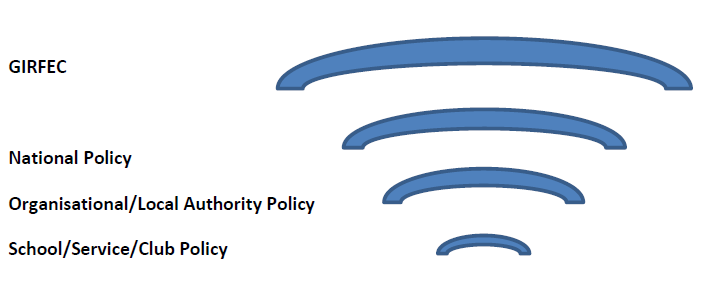
Our approach is to support organisations and local authorities to develop anti-bullying polices that are in step with the National Approach. This means they are underpinned by the same values of fairness, inclusion and equality, and there is a consistent definition of bullying and consistent guidance on what to do when bullying happens. It means that your local authority, school and sports club should have the same definition and use the same language when talking about and when you are challenging bullying.

The 2011 evaluation of respectme highlighted that adults and young people having a shared language and understanding on bullying was critical to success and in creating environments where bullying cannot thrive. respectme  helps an organisation or a local authority to develop a strategic overarching anti-bullying policy that is cascaded to each individual service, club or school within it.

We advise on and support a process of collaboration; getting the views of children and young people, parents, adult’s, staff and volunteers. This way the policy does not just appear out of the blue and it can be launched in the knowledge that the right people were asked and included.

Experience has also shown that the most effective way to integrate this into local practice, the most effective way to ensure individual schools, clubs or service have a good and well understood policy, is for them to take the organisational one and develop their own one locally.

This policy will be underpinned by the same values, definition and crucially it will mirror the process of collaborating with children and young people, parents and staff. This should lead to a shorter local policy that starts by referencing the organisational or local authority policy. This allows schools to say, ‘Glasgow City Council states.. and at Bellahouston Academy we do this…’ or ‘Aberdeen City Council sates… and at St Mary’s our pupil council said … about bullying.’ This is taking national policy and making it relevant locally. If every school just put a copy of the local authority policy on the shelf, there would be no ownership of it, no journey embarked upon where local issues and local parents got involved and this approach is far less likely to be successful.

This is not about doubling the workload but ensuring a very robust policy framework is in place to help those being bullied and to support those who are dealing with it. So in Scotland we would expect to see an individual school, service or club with an anti-bullying policy that is developed to reflect the organisational or local authority one. respectme will help ensure the local authority or organisational policy reflects the National Approach.

This means that in practice an individual badminton club, primary school or football club can have a policy that shares the values and principles of the organisation they are part of or that governs them. That organisation should have a policy that reflects the National Approach. This consistent language and framework should benefit children and young people, their parents and cares and those who work with them. Everyone gets the same message.

So when a parent asks for the schools policy, they should get the individual school policy but also see the local authority one, as this will give greater detail on what they can expect and what routes to take. It isn’t one or the other, best practice is both. If you are a local club not part of an organisation, you governing body, such a Sport Scotland will have a policy to reference, if you are even more local and not part of this set up, you should still use the National Approach as a guide for your policy – this will ensure it is in step with the policies the same children and young people will experience at school or other places.

All of this is designed to ensure that policy is more consistent at every level, local, organisational and strategic.

There are some things you need to put in you policy whether you are an organisation, a youth club  or a school and one of these is a commitment to challenging prejudice-based bullying. Every single policy must be explicit about the Equality Act 2010 and each of the protected characteristics.  This has been covered in other blogs on this site. We know from the research we did for the EHRC that where policies explicitly mention things like homophobia biphobia and transphobia, racism, gender-based prejudice etc.  staff feel more confident to respond to this type of behaviour when they see it. The policy gives them permission to challenge and discuss these issues and crucially, raises an expectation that they will challenge prejudice-based bullying.

There was also evidence to suggest that establishments where their policy does not mention specific types of prejudice-based bullying ,  practice is not as good and both staff and children and young people felt less confidence about dealing with this kind of bullying.

Policy is a journey, a values based journey to share understanding of what bullying is and what is expected of everyone involved what behaviour you can expect and how you can expect people to respond. It gives us a framework for anti-bullying practice and something we can and should be held accountable to.

So don’t be put off, get it right, make it inclusive and that in iself is a big part of developing environments where bullying cannot thrive, why would we not do that?
For more information on what goes in your policy, visits www.respectme.org.uk

This is designed to illustrate the process and context for anti-bullying policies at every level and how we can ensure consistency in overarching values and principles from a Government level to an individual school or youth club level.


Brian


Bullying in Scotland 2014 Reserch Survey Findings

I have posted a brief summary of the results of a survey carried out earlier this year – I will be posting a lengthier blog in the not too distant future  discussing the findings in greater depth but for now at least – here is a quick snapshot of what children and young people told us

The research

The primary aim of this piece of research was to obtain a picture of how children and young people are experiencing bullying in Scotland in 2014.

This research was designed to:

·         Identify the types of bullying that is experienced by children and young people.

·         Give a clear picture of where bullying happens and where online and offline/face to face experiences differ or crossover.

·         Identify from children and young people’s own experience what they feel works and what is less helpful.

·         Identify where children and young people go online and what technology they use to get there.


An online questionnaire was designed and tested and distributed to all schools in Scotland in May and June 2014. In total, there were 8310 responses, of which 7839 were useable. Responses came from all over Scotland with all 32 Local Authorities represented. Respondents were aged between 8 and 19 years old. Sixty five per cent were 12 – 14 years old.

This was an open survey and the findings presented here represent only the views of the children who took part.

Three focus groups took place with 45 young people to get a more detailed insight into children and young people’s experiences of bullying – in particular, their thoughts on what happens online and in person, where these two are different and where they crossover.

Key findings


The key findings from the survey are as follows:

  • 30% of children and young people surveyed reported that they have experienced some sort of bullying behaviour between the start of school in August 2013 and June 2014. Of this 30%:

§  49% experienced bullying in person

§  41% experienced bullying both in person and online

§  10% experienced bullying online only.


  • A number of children and young people had more than one experience of bullying. Children and young people surveyed reflected 12,003 experiences of bullying behaviours. Of these experiences: –

§  60% took place in person

§  21% took place both in person and online

§  19% took place online only


  • 92% of children and young people who were bullied knew the person bullying them (91% online and 92% offline). Anonymity therefore may not be what is driving bullying online.

·         Behaviours such as name calling, hurtful comments and spreading rumours that make people feel angry, sad and upset happen both face to face and online.

·         Children and Young people employ a range of strategies to cope with bullying; some are more successful than others.

§  Almost half (48%) of children and young people who are bullied tell their parents.

§  Friends and teachers are also providing support to a high number of children and young people who are bullied.

·         The most successful anti-bullying interventions are embedded within a positive ethos and culture and don’t just focus on individual incidents.

  • Children and young people’s use of technology, especially mobile technology and social media, is woven into their everyday lives.
  • The majority of children and young people (81%) consider their online friends to be all or mostly the same friends they have in real life
  • Children and young people access internet content on mobile devices, such as phones and tablets, more than other devices such as  PC’s or laptops.
  • Google, YouTube, Snapchat, Instagram and Facebook are the most popular websites and Apps used by children and young people when they go online.


  Next Steps


We will further analyse the data we have collected and use it to help develop effective policy and practice around bullying. The data is likely to help us to address some questions more effectively including: –

·         Given the relatively low proportion of exclusively online bullying, and the similarity of online and offline bullying behaviour, to what extent is a specific response to online bullying needed?

·         What are the appropriate responses to gender specific differences in experiences of bullying?

·         How can we help schools to further develop an anti-bullying ethos? And how can we continue to ensure children and young people are involved and included in this process?

·         How can we continue to support parents to respond when their children tell them about being bullied?

·         How can schools further help children and young people learn from other pupils about the strategies that they have found useful?

 
Reflections on bullying – some core underpinnings and a definition
Brian Donnelly Director of respectme, Scotland’s Anti-Bullying Service.
A great deal of learning has taken place over the five years respectme has been delivering anti-bullying training, policy support and campaigning.  There are some core messages that underpin the approach we take which challenge existing thinking on bullying; I shall explore some of these in this refection. This reflection is also based on work done in partnership with Professor Howard Sercombe University of Strathclyde to develop an academic synthesis reflecting some of the theoretical underpinnings of the approach taken by respectme.
We challenge the traditional belief that persistence and intent are the defining elements of bullying situations. Instead we have focussed on the impact the behaviour has on individuals. Our reasoning for this is that it’s our role to provide pragmatic and practical responses, resources and skills that can be implemented by parents and professionals. What you do about bullying is much more important than how you define or what criteria you apply to determine if an incident merits the label. In our experience, many children and young people reflect a clear understanding that something needs to only happen once and it can be bullying, yet most definitions, and often anti-bullying policies, refute this, stating that the behaviour has to be repeated over a period of time.   The actual intervention may not be repeated, but the threat will be sustained over time. Typically, the threat will be sustained by actions, looks, messages, confrontations and physical interventions or the fear and anticipation of these.
Similarly intent is not only difficult to prove but easily denied and this should not be used as criteria for this very reason. Many of the behaviours experienced are subtle, indirect and designed to unsettle and make people feel left out; again it is the impact that needs to be the focus for intervention.
respectme focuses on the need to develop interventions and approaches that recognise the impact bullying has and works to ensure adults are able to deal with it effectively and confidently. This involves supporting partners to come to a shared understanding of what bullying behaviour can be. When faced with an actual situation, how you define it is less important than what you do about it. This deflects the intervention from a dispute about whether or not a presenting situation should be classed as a bullying situation, and turns attention to where it ought to be focused: to the person directly affected. Then, the intervention becomes much more straightforward; really a matter of three questions:
1. What is happening?
2. What does the person in distress want to happen?
3. How are we going to make that work?
Bullying behaviours can include: 
·                Being called names, being teased, put down or threatened
·                Being hit, tripped, pushed or kicked
·                Having belongings stolen or damaged
·                Being ignored, left out, or rumours spread about you
·                Receiving abusive text messages or emails
·                Behaviour which makes people feel like they are being bullied
·                Being targeted because of who you are or who you are perceived to be
This is not an exhaustive list; there may be other behaviours that can be classed as bullying, these are what we would call ‘practices of domination’.

Children and young people can experience bullying for a variety of reasons; including where they live, their sexuality, gender, disability, the colour of their skin, what clothes they wear or what team they support. 
The one thing that these have in common is difference or perceived difference. Bullying is a relationship. It’s a two way thing. The attempt to dominate needs to be answered by subordination in order for the bullying relationship to be established. Bullying is therefore not primarily a description of a person or behaviour but a kind of relationship. Those who bully and those bullied are in a relationship with each other. What differentiates bullying, we believe, is the impact it has on a person’s agency. This ‘agency’ is their capacity for effective action and feeling in control of their lives. Bullying strips individuals of the capacity to do this.

As a result of the work and discussions with Professor Howard Sercombe, we defined bullying as:
“A relationship of violence involving practices of domination that strip another person of the capacity for agency, using interventions carrying the sustained threat of harm” (Sercombe and Donnelly 2012)
The aim of interventions must be to restore agency, to replace that which was taken away. We must base our responses on this question: ‘how can I respond in a way that gives this person back their agency, to help them regain that sense of control over who they are and what they do?’ Not just ‘how do I fix this?’
Adults who adopt this perspective can make a much more effective intervention. These core principles are underpinned by our values of fairness, inclusion and equality and are supported by our commitment to provide practical resources for adults to use that promote and protect Children’s Rights. These values and principles apply when dealing with children and young people who are bullying others. They need to understand what the behaviour is that is unacceptable, why it is unacceptable, what the consequences may be and what is expected of them in future. They may also need help to repair relationships.
Another core message that underpins the work of the service is our approach to labelling, respectme does not label children and young people as ‘bullies’ or ‘victims’. Care needs to be taken because labelling is not without its risks, labelling a child or young person on the basis of bullying behaviour can result in a confirmed identity as a ‘bully’ or ‘victim’ resulting in ongoing behaviour patterns based on this identity. respectme has developed approaches to working with bullying which hopefully avoid the labelling dilemma. A core theme in training, policy development and campaigning has been the exploration of the value judgements that lie behind labels.
This is not to dilute behaviour but is to keep the focus of the adult’s responses on the behaviour that is problematic, rather than the assigning characteristics to those involved. This is a solution focussed approach that is designed to help people change the way they behave, rather than attempt to change who they are. We help people change by telling them and naming the behaviour that is unacceptable, being clear that what they are doing is bullying and that it needs to stop.
I look forward to sharing more of the learning in the coming months on topics ranging from cyberbullying to what our 24 month evaluation highlighted as critical factors for success.
Brian Donnelly
January 2012