
Anti-Bullying Policy – a journey

Everyone’s favourite thing I know but developing an anti-bullying policy is a crucial step for us all – it is vital if we want to create environments where bullying cannot thrive. Environments where bullying does not thrive are known for the quality of the relationships on show, they are known for being inclusive and safe and  they listen. This does not happen by accident, there will be effective leaders in these places, valued staff, children and young people. There will be shared aims and an understanding of what it means to go there – to be a part of it.

Part of what builds a shared understanding and shared vision is that it is written down and explained, it is shared and understood. It sets the boundaries, ethical and professional, for how people are expected to relate to each other and allows us to hold each other accountable. Places where the tone and mood is set by one powerful individual can be effective but a top down approach which relies on unwritten rules, presents challenges for new faces as well as for those who may not be entirely in step.

I like to explain culture as ‘the way things are done here’.  I want my children to go to a school where they value difference, where they care about the pupils, where they role model good relationships and listen to the pupils. Not a culture based on fear or a domineering Head or a Unit Manager and their acolytes. I have worked in places like this and one of the only ways I could hold colleagues appointable and start to influence change was to include and reference what polices we were supposed to be operating within.
I know many roll their eyes at the thought of policy and, given some of what we have to read and assimilate at times, it’s an understandable response. When we are looking at responding to bullying and, crucially, creating an environment where bullying cannot thrive, we need a written commitment to how we should expect people to behave.

In places where the culture is ‘Well, we all know how to behave and we all know what bullying is’ I ask, ‘How do you know and are you sure everyone thinks the same way?’ In the absence of a written statement that states ‘this is what we mean by bullying here is how you should be treated’ people remain free to interpret behaviour themselves and decide if they feel a response is warranted.
We know from experience that this is way too subjective and people’s own values and prejudices influence this hugely. If you think bullying is ok and didn’t do you any harm, you won’t respond effectively, if you think being gay is wrong, you can’t actually respond effectively to homophobia. If you think online bullying is nothing to do with you then you won’t be able to help anyone deal with it when it is happening to them.  This is why we need  policies, they are not theanswer but they are a part of the answer.

Based on the work we have been doing at respectme for the last nine years, around developing and influencing policy, we have found effective ways to ensure policies are better understood; they are co-produced with stakeholders, especially with children and young people.There is no legal requirement in Scotland for schools to have an anti-bullying policy, but it is  good practice and those who regulate and inspect you will expect to see one.

But we know that employing a ‘scatter gun’ approach to policy development does not work, by this I mean working with any one school at a time. There is no evidence to suggest this is an effective way to improve practice across the country, instead we get very patchy and inconsistent anti-bullying practice.  At respectme we help develop policies at an organisational level, these are then cascaded locally to ensure a more consistent picture and a greater reach.

In Scotland we have a National Approach to Anti-Bullying, which sets out the Government’s expectations. A revised version of this will be launched  this year and it will be called ‘Respect for All’. respectme has influenced this a great deal and our experience of developing and implementing policy has been central to this. I will describe the rationale for the process first rather than just what you need to put in a policy.

Our approach is to support organisations and local authorities to develop anti-bullying polices that are in step with the National Approach. This means they are underpinned by the same values of fairness, inclusion and equality, and there is a consistent definition of bullying and consistent guidance on what to do when bullying happens. It means that your local authority, school and sports club should have the same definition and use the same language when talking about and when you are challenging bullying.

The 2011 evaluation of respectme highlighted that adults and young people having a shared language and understanding on bullying was critical to success and in creating environments where bullying cannot thrive. respectme  helps an organisation or a local authority to develop a strategic overarching anti-bullying policy that is cascaded to each individual service, club or school within it.

We advise on and support a process of collaboration; getting the views of children and young people, parents, adult’s, staff and volunteers. This way the policy does not just appear out of the blue and it can be launched in the knowledge that the right people were asked and included.

Experience has also shown that the most effective way to integrate this into local practice, the most effective way to ensure individual schools, clubs or service have a good and well understood policy, is for them to take the organisational one and develop their own one locally.

This policy will be underpinned by the same values, definition and crucially it will mirror the process of collaborating with children and young people, parents and staff. This should lead to a shorter local policy that starts by referencing the organisational or local authority policy. This allows schools to say, ‘Glasgow City Council states.. and at Bellahouston Academy we do this…’ or ‘Aberdeen City Council sates… and at St Mary’s our pupil council said … about bullying.’ This is taking national policy and making it relevant locally. If every school just put a copy of the local authority policy on the shelf, there would be no ownership of it, no journey embarked upon where local issues and local parents got involved and this approach is far less likely to be successful.

This is not about doubling the workload but ensuring a very robust policy framework is in place to help those being bullied and to support those who are dealing with it. So in Scotland we would expect to see an individual school, service or club with an anti-bullying policy that is developed to reflect the organisational or local authority one. respectme will help ensure the local authority or organisational policy reflects the National Approach.

This means that in practice an individual badminton club, primary school or football club can have a policy that shares the values and principles of the organisation they are part of or that governs them. That organisation should have a policy that reflects the National Approach. This consistent language and framework should benefit children and young people, their parents and cares and those who work with them. Everyone gets the same message.

So when a parent asks for the schools policy, they should get the individual school policy but also see the local authority one, as this will give greater detail on what they can expect and what routes to take. It isn’t one or the other, best practice is both. If you are a local club not part of an organisation, you governing body, such a Sport Scotland will have a policy to reference, if you are even more local and not part of this set up, you should still use the National Approach as a guide for your policy – this will ensure it is in step with the policies the same children and young people will experience at school or other places.

All of this is designed to ensure that policy is more consistent at every level, local, organisational and strategic.

There are some things you need to put in you policy whether you are an organisation, a youth club  or a school and one of these is a commitment to challenging prejudice-based bullying. Every single policy must be explicit about the Equality Act 2010 and each of the protected characteristics.  This has been covered in other blogs on this site. We know from the research we did for the EHRC that where policies explicitly mention things like homophobia biphobia and transphobia, racism, gender-based prejudice etc.  staff feel more confident to respond to this type of behaviour when they see it. The policy gives them permission to challenge and discuss these issues and crucially, raises an expectation that they will challenge prejudice-based bullying.

There was also evidence to suggest that establishments where their policy does not mention specific types of prejudice-based bullying ,  practice is not as good and both staff and children and young people felt less confidence about dealing with this kind of bullying.

Policy is a journey, a values based journey to share understanding of what bullying is and what is expected of everyone involved what behaviour you can expect and how you can expect people to respond. It gives us a framework for anti-bullying practice and something we can and should be held accountable to.

So don’t be put off, get it right, make it inclusive and that in iself is a big part of developing environments where bullying cannot thrive, why would we not do that?
For more information on what goes in your policy, visits www.respectme.org.uk

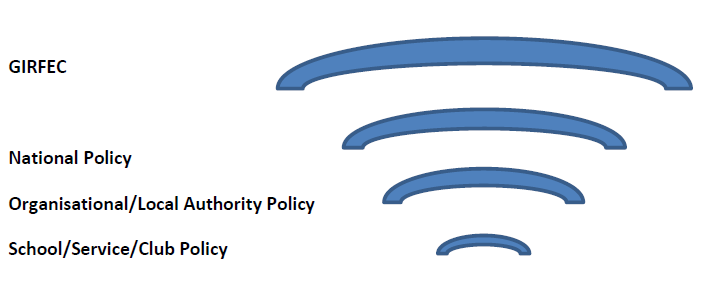
This is designed to illustrate the process and context for anti-bullying policies at every level and how we can ensure consistency in overarching values and principles from a Government level to an individual school or youth club level.


Brian


Do we really all have to be friends?

The line that gave respectme its name has served us very well over the years and made for a very popular poster and video campaign – ‘You don’t have to like me, agree with me or play with me… but you do have to respect me’. The thinking behind this was the need for a way to describe how we wanted to help children and young people shape the terms for relationships and interactions with peers.

While this sounded quite catchy and lends itself well to a campaign – I always wanted to it have substance – and that is why we always follow this up by exploring what does this statement actually mean or what does it actually feel or look like for children and young people?

It is a nice demand to make of people I know but again, what does it mean. For the most part – it means simply leaving someone alone – you don’t need to connect with them, learn about them, understand them or become friends with them – just let them be.

The example I tend to use when discussing this, relates to an experience I had when my second oldest was at nursery. As reputations were being built and lost around the sandpit I heard the teacher tell the boys and girls who were playing and getting out of hand that ‘they should all be friends and play nicely’. This was of course said with warmth and with the best of intentions but at the time it really got me thinking – ‘’Do they all haveto be friends?’ how realistic an expectation is this?

Now, if a bunch of 4 year olds cannot behave around the sandpit we need to intervene and let them know how they should behave but do they all need to be friends? No – should they be expected to play near each other in a civilised way? Yes – perhaps a better response is along the lines of ‘if you are all going to play here together you need to be nicer to each other, no grabbing or shouting and you take turns – that’s one of the rules here’.

That is an easier boundary to set and easier to role model, if you tell them they need to be friends you are setting up an unrealistic expectation that they can’t possible manage – friends with everyone in your class? Are we as adults expected to be friends with everyone we work with? Do we even like everyone we are related to at times? Of course not.

I know for some this is not a huge issue but friendship is one of the first currencies children have to withhold or bargain with – it is a very powerful tool in early years and as such I think we can frame it more effectively. I would rather see a group of P1’s who can get along on different tasks, are respectful of each other and make friends on their terms. This also lets us talk about what it means to be a ‘good friend’ and help them understand that there will always be a wide group of people around them throughout school, some you’ll be friends with. Some you’ll know and say hello to and some you won’t get on with or agree with.

The skills needed to understand and negotiate this will serve them well in life not just school. Anti-bullying agencies get a bit of stick at times because the impression they give is that all they want is for everyone to be nice to each other and in fact this is unrealistic – I think it’s no bad thing to want everyone to be nicer but I agree that it’s not realistic.

What I do believe is that we should be asking children to respect their peers and that can mean a whole range of things. It can include talking and listening to someone and perhaps becoming friends, or it can mean fixing what was once a friendship or it can mean learning to be quiet and not shouting at or about someone you don’t like. I think friendships are vitally important to our children and young people – they rely on them, value them and as they get older, they turn to them for support and comfort – all this message and these campaigns seek to do is to help frame an understanding of what it really means to be friends.  

Learning that it is okay not to like someone, that it’s okay not to agree with them is important – it’s what you do that matters. Not being friends does not have to mean that you are enemies. That is a message I have seen young people benefit from exploring on many occasions.

If you think about it there must be a few people in your life you don’t like, you don’t and never will agree with – you don’t hound and abuse them at every opportunity – you may have learned the hard way that a family Christmas dinner is not the time to get these feelings off your chest. It might be a colleague or your boss – most people learn to use their developed social skills that enables them to work effectively or not fall out with the whole family.

If you pick on, exclude or verbally abuse someone in person or online you don’t like or agree with then that’s the kind of bullying that will cause problems for everyone – if you are able to let them walk by, be online or in the corridor without you responding in some negative way – then everyone will be a lot happier.

We will always respond to bullying more effectively when we focus on what someone actually did and the impact it had. If they behaved in a way that is unacceptable then we focus on their actions and what they should be doing in future.  This will be more effective than trying to fix or reframe a dynamic between two people that might not need ‘fixed’- nor will it ever fit into what we might think a ‘friendship’ is.


Brian

Online Bullying – Evidence to Education and Cutlure Committe


I have posted this briefing that was submitted ahead of the Education and Culture Committee Evidence Session on online bullying – it is an extended version of the briefing posted earlier on this blog 


The service provides strategic policy support, offers skills development training and campaigns to raise awareness. The service was externally evaluated between 2009 and 2011 and was found to be a ‘catalyst for change’ and was a ‘credible’ and ‘robust’ anti-bullying service. The service was instrumental in developing the National Approach to Anti-Bullying for Scotland’s Children and Young People and ensures all stakeholders operate in-step with this approach.
 

respectme’s resources and approach to anti-bullying is recognised internationally, we have delivered training and materials across Europe and the UK as well as the US. We work with all adults who play a role in Children’s lives – parents to policy makers and we have trained teachers, social care staff, foster carers, football coaches, residential workers and many people in many other roles.

Bullying is behaviour that makes people feel frightened, hurt, threatened and left out. It impacts on a person’s ability to feel in control of themselves (their ‘agency’) and to respond effectively. This behaviour can harm physically and emotionally and the threat is typically sustained. This behaviour takes place in a variety of places, including on-line.


Online bullying was an emerging issue when the service launched early 2007 and at the request of the then Minister, respectme delivered a campaign on cyberbullying that urged parents to ‘connect’ with what their children were doing on-line not ‘disconnect’ from the internet. We found that parents and adults who understood how social media worked, what it was used for and how to make it safe or monitor it, were much more confident when dealing with bullying that happened on-line.


Over the year’s respectme developed resources, web content and a very popular training event on cyberbullying. We were able to refine and develop confidence with our core messages about online bullying and communicate these to our stakeholders through newer campaigns and resources aimed at adults and at children and young people. Our learning has now seen us bring the core messages on online bullying into our generic anti-bullying training.


These key messages include:


Bullying online is all about relationships – not technology We must focus on equipping young people with the skills to conduct themselves online in a more respectful manner; the skills to manage these environments safely, and to develop their confidence and abilities to negotiate relationships and problems. This is built on promoting and developing resilience. But we also have to equip parents with the knowledge and understanding about how these sites work; how to make them safe and, most importantly, how to talk to their children about using them.


‘Cyberbullying’ is bullying – it is still about relationships that are not healthy or being managed or role modelled well. It is behaviour done by someone to someone else, it is the ‘where’ this is taking place that is new. The behaviour appears to be migrating, as children spend more time on-line, the behaviour they have always exhibited and experienced comes with them.


It is important to include cyberbullying in your policies and procedures on anti-bullying and not see it as something entirely separate – it is still rooted in relationships between people. Our work and international research supports our assertion that you deal effectively with bullying that happened online as part of your whole approach to bullying. Carving it off as something different dilutes the reality of bullying experienced by children and young people – this is that they can experience bullying online and in person simultaneously.


The internet is a place, not a thing – for many the internet is a tool that they use for a variety of things, buying, sending messages or research. To most children and young people it is a social space that they spend time in and use to stay in touch with their friends. This principle underpins all of our anti-bullying work in this area. This led to a very successful video campaign in 2011 called ‘She’s still going somewhere’, the message for adults was, whether your child is going into town or online, they are still going somewhere and you need to be just as interested and concerned about where they are going and who they are going with.


Like all places children and young people go to, there are risks.


Children and young people do not differentiate a great deal between friendships online and in person – most of their interactions on-line or using their smart phones is with friends and people they interact with in other areas such a schools or where they live. This is not to say they do not know the difference but it is ads natural for your friendships to be evident in both your day to life online and where you live or go to school.


Children and young people use this to communicate –the purpose of using smart phones, consoles or laptops is primarily about staying in-touch with friends, this is as important for young people today as it was 40 years ago. They have different means at their disposal but the principle is the same.


Adult fear and anxiety – has been the biggest hurdle in dealing with cyberbullying. This has had a very high media profile at times and it appears ’new’ and for parents or adults who do not use social media or connect with their friends using the internet, this is a challenging and at times bewildering experience. There are so many types of phones, connections and complex safety features and so on. That is why respectme’s training focusses on developing adult skills and confidence and their understanding of how and why technology is used this way.

We have developed a two and a half hour training session for parents that we will be piloting across the Central belt later this year. This session will involve some ‘hands-on’ experience on social networking sites and leaning about safety settings and how they work.


Lots of colleagues have said they are ‘technophobes’ or are not ‘tech savvy’ and have voiced how much they dislike Facebook or twitter. We have maintained that if you work with children and young people or are a parent or carer – that is no longer good enough. You need to know! For some that will require a real effort to spend time and utilise the relationship they have to learn this. We cannot abdicate responsibility for this to software. We need to connect and learn about how young people use the internet and the phones or laptops they access it from. They use it mainly to talk to and meet their friends.


Many adults have experience of managing risk when working with children and young people, this is a new place for us to consider. We need to be as imaginative and creative with the internet as we have been in other places.


respectme undertook extensive research on October 2011 on this issue that both confirmed our messages and informed the work we do.


This research involved 3,944 young people from 29 of Scotland’s 32 local authorities aged 8 – 19 years. It confirmed that children and young people are online almost every day. They use phones and laptops, boys also use games consoles to connect with friends and socialise. For the most part, the friends they talk to at school are also the friends they chat to on-line. They do not draw any difference between talking to a friend on the phone, instant messaging or on the way to school – it’s all talking to friends.


16% say they have been cyberbullied – this is reflective of the findings from colleagues in the rest of the UK. 25% worry about cyberbullying,


55% say they are online every day for 1 – 3 hours, nearly 10% claim they are on for 5 hrs. or more


63% of children bullied online knew the person who was doing this and 40% of the time this carried over into school. Children who had been bullied on-line stated that reading a nasty comment was worse that hearing it or knowing it had been said. Children who had not been bullied on-line were ambivalent about the difference in impact.

There is a real fear that anonymity is pushing this behaviour online – however there is little research to support this – what we do know is that believing they will no get caught and not fully understanding how permanent posting are online link to bullying and aggressive behaviours more than anonymity – many social network sites have a /name’ culture and most abusive behaviour online is not actually anonymous.


The impact of this behaviour is the same as the impact of other types of bullying, fear, anxiety and worry about repercussions. It is likely for many children and young people that if they are being bullied, say in school, it is highly likely they may also experience bullying behaviours online as well.


71% of children who were bullied would like to tell a parent or carer, 43% would tell a friend and 31% would want to tell a teacher.


This year will also see respectme undertake new research into children and young people’s experiences of bullying online and off. This research will enable us to help parents and professionals get a clear national picture of how young people are experiencing bullying in 2014. Crucially this will support and influence effective responses that recognise relationships play out on line and face to face more than ever.


Schools have struggled at times to deal with bullying that happens on-line as they believe it happens ‘out of school’, respectme’s take on this is that bullying happens to individuals, the impacts are felt by them and they take this with them wherever they go. If they tell their teacher something happened and they are worried, like any disclosure of this kind, teachers and schools must respond in a supportive way. Children will be telling a teacher for good reason; they believe they can help them.


Cyberbullying can be more intrusive and children and young people may find fewer ‘escape routes’ as switching off their phone is rarely an option. While messages can be blocked, deleted or reported, they can be seen by hundreds of others within minutes and incidents can spiral out of control very quickly. A comment made while angry to a friend can be seen and shared in no time at all.


respectme has develop very successful guidance for children and young people on bullying, staying safe and their own behaviour on-line as well as resource for adults. There is a need to help adults develop skills and confidence in this area though. There is still a gap between what they currently know and what they need to know about the platforms and devices children and young people use.

A new publication for parents and carers will also be delivered this year and this will cover anti-bullying advice including online bullying.


Brian Donnelly


Director respectme


February 2014

Before you give advice on bullying, get some

‘Before you give advice about bullying, get some’, was the title of last November’s Anti-Bullying Week campaign. I wanted to take a few moments to reflect on the success of the campaign and re-visit the key messages that underpin it.

For us, this was one of our more controversial messages – the scenario we chose was deliberately challenging. A father telling his son the only way to deal with bullying was to hit the person doing it, hit them hard enough that they cannot hit back. Here it is – http://www.youtube.com/watch?v=_hE6Cn8yqxI

We were not trying to make the Dad the villain of the piece. Hearing that your child is being bullied brings out an understandably emotional response. It’s difficult for parents and carers to hear.  It’s difficult to hear and you therefore not always at your best when you respond.

Sometimes the advice we give children and young people at this time isn’t necessarily the best advice. Being told to hit someone back if you are being bullied is actually a common response; children and young people have told us this is something they do hear. They have also told us it is one of the least helpful things that they are told to do.

We know it exists as an option to use but we know, by and large, it’s not necessarily the best or safest option to take. It doesn’t take into account people that can’t or won’t hit back; people who do not have the capacity to hit, people who are, say, in a wheelchair or who are too scared, or people who don’t like the thought of violence.  So there always has to be an alternative.

Most people don’t go through life answering challenges and relationship difficulties by resorting to violence, yet we tend to tell children if they are being bullied they can resolve this by using violence – whether they are being physically bullied or bullied online. We would not necessarily give this advice to a friend who felt they were being bullied at work.

I believe this is something of an adult fantasy – that our child will be able to assert themselves and no-one will bother them as a result. We do as a collective like the idea of retribution; we love films and books about it. It may appear like natural justice that someone who is bullying another gets their comeuppance, but the reality is that a violent response usually leads to more violence – children and young people do not always share this wish, they want bullying to stop with the minimum of fuss. 

When I get asked, and I do get asked, if I think boxing or martial arts will help someone’s child (usually a boy) if they are being bullied I always ask the same question, ‘what are you hoping this does for your child?’ If it is to build their confidence, meet other people, stay active and enjoy a sport and they want to do it – then fine, who could object to that? If however it is so that they feel their child is capable of ‘sorting out’ anyone who tries to mess with them, then I suggest they reconsider their reasons. Not every child who is being bullied wants to learn Karate to feel safer – most of us go through life without needing this.

We discussed with people before making this video the notion of showing the ’right way’ and the ‘wrong way’. The thing is there is never one, single, answer when it comes to bullying, it’s about knowing how to think about it and how to approach it.

‘So what should I do?’ was the question we were asked.  Sometimes you have to ask your child, ‘what do you want to happen?’ ‘Tell me what you have done so far?’ ‘What would you like me to do?’ ‘What do you think would happen if, say, I was to go up to the school and talk to them about it?’.

If they are worried that you would make it worse, you might have to try something else because most children want bullying to stop with the minimum of fuss. ‘What do you think would happen if I spoke to someone’s mum?’ or ‘Is there someone else you can talk to?’

It’s about exploring options; thinking about what you can do and sometimes having to say, as a parent, ‘look if I’m worried and I don’t think you’re safe, I’m going to step in’, and explain why you are doing it.

The temptation to run off and solve it is an understandable one, but we should always take a moment, pause and think, ‘how do I give my child back a sense of being in control?’, because it’s that sense of being in control that has been taken from them, and that has to focus your response.

We know that bullying takes something away from people; that is one of the things that makes it different from other behaviours. It takes away people’s ability to feel in control of themselves and to take effective action.  We callthis our agency.

It’s important to remember this when we respond to bullying behaviour.  If we can accept that it takes something away from someone, our focus has to be on helping them to get it back; helping them get back that feeling of being in control and being themselves again. That’s why we have to involve young people in what they want to happen, what they would like to happen, and what they are worried about happening.  And sometimes we need to take a lead from them as to what pace we go at. If we can do that, we can help restore that feeling of being in control. 

One of the most common responses we have had to the video is that ‘It really makes you think’  – some colleagues told me that they went home and had a very difficult conversation with their partner about what advice they would give their son or daughter and would it be any different.

We were lucky enough to work with great partners and great actors to make this video and to get it on the television 6 times over the week – as a result we now know the advert was seen by just over 1.4 million people during anti-bullying week – it was viewed in full on You Tube, over 35,000 times in one week and that around 70% of the people who viewed it were male.

Our website activity increased by around 70% during anti-bullying week so we can reflect on a very positive campaign and along with our national conference attracting over 230 people and our first ever national awards, we have raised the bar somewhat for 2014’s anti-bullying week – which for those who like to plan in advance is November 17 – 21 2014.

Brian

Never judge a book by its label

I have been thinking a lot about what to chat about at this time following a very busy and successful anti-bullying week. There were so many issues covered in the build up to and since, everything from on-line bullying to the challenging messages contained in this year’s advert. We were able to get our advert on STV for the very first time and we await the figures for this. Anti-bullying week also seen the advert watched on YouTube 35,000 times in one week. The ‘click-through rate’ for this ad is apparently twice the industry average. You can view it here http://bit.ly/19d3bGO

There is also supporting videos discussing the campaign and on responding to bullying www.respectme.org.uk

I also had the pleasure of attending an International Anti-Bullying Conference in Nashville in early November. I spoke to many colleagues at this event and one issue that came up more than most was labelling. I had also had some feedback and discussions with other people about respectme’s approach labelling prior to this so I decided it was something to revisit and reflect on.

One of the first things I noticed at the conference was just how anti-bullying is an industry in The States. The volume of books written on the subject is staggering and having spoken to a few aspiring authors, it is a crowded market that is not easy to crack. A glance at many of the books on show – especially the ones aimed at younger children or the parents of younger children were a little concerning. Titles such as:  ‘How not to be a Bully’, ‘Llama Lama and the Bully Goat’. ‘What to do if your child is a Bully’ and other similar titles. This is not to single out or to critique any particular title just the very consistent use of the word and the label.

The large number of books like this made it easy to engage in conversations about labelling with many other delegates. Every speaker I heard talked about ‘Bullies’, ‘Victims’, ‘Bully/Victims’ and ‘Pure Bullies’. A part of my input covered the approach we have in Scotland to this explaining how respectme does not label children and young people as ‘bullies’ or ‘victims’.

Our approach reflects the view that care needs to be taken because labelling is not without its risks, labelling a child or young person on the basis of bullying behaviour can result in a confirmed identity as a ‘bully’ or ‘victim’ resulting in ongoing behaviour patterns based on this identity. respectme has developed approaches to working with bullying which hopefully avoid the labelling dilemma. A core theme in training, policy development and campaigning has been the exploration of the value judgements that lie behind labels.

This is not to dilute behaviour but is to keep the focus of the adult’s responses on the behaviour that is problematic, rather than the assigning characteristics to those involved.

The point is that if you label children a certain way – there is a significant risk that they effectively ‘live up’ to that label and all of their subsequent behaviour is viewed through this prism– which is unfair as no one is ever just the one thing. We hear of many situations where bullying has been overlooked or ignored because either the school or the parents did not think the person doing it was a ‘bully’, perhaps because they were clever or popular and articulate – however, on many occasions their behaviour was bullying. Our work tries to take away the perception people may have about who is doing it and focus on what the person actually did – bullying and what was the impact.

The response to this was warm and many delegates commented on how this approach would actually help them yet acknowledged that it would be a real struggle to get other people to move in the same direction.

‘Bully’ has become a word that commands attention; it elicits an emotional response from adults, an understandable emotional response that sees the children who do this dehumanised and caricatured from an early age, this can also reinforce the notion that it’s always someone else’s child who does this. This is not to suggest that the behaviour of some children towards other children is not outrageous and damaging – it can be.

The word itself conjures up particular images for each of us, ones that may represent our own experiences too. I do not seek to take that away from anyone as that is a natural response  – my role in this is to find solutions and try to help how we respond to bullying. Because that is what matters surely? How we respond to behaviour and help someone feel safe and feel like themselves again is what makes a difference. How we help children to see how unacceptable their behaviour is and what is required of them to share social spaces and classrooms with their peers. That is what makes the biggest difference.

We have had over 30 years of work in anti-bullying and somehow people persist in focussing on what a ‘bully’ is, the type of person who bullies, or who follows, or who is easily bullied, rather than what people actually did and the impact it had. Almost as if when we reach the point that everyone can accept that a particular child is indeed a ‘bully’ that’s our job done.

Children bully other children for a number of reasons, it’s not always because deep down they are afraid and scared or lack self-esteem – they might be but they can also be confident children with an abundance of self-esteem – they will now exactly what the impact is, that might be why they are doing it. The thing is no two incidents are ever identical – the dynamic is always affected by who is involved.

Success in dealing with bullying is usually rooted in having an approach like this:

What was the behaviour?

What impact did this have?

And what do I need to do about it?

This sees you deal with behaviour and impact – if the behaviour is completely out of character then that might influence any subsequent consequences, if it is the third incident this week, then that too will affect your response. If a child coped well with the attempt to bully, then that night influence the amount of support they need. This is the crux of the matter for me – there is no ‘one-size-fits-all’ response. Success requires you to take the time to look at each incident and find a way forward with the young people involved that reflect their strengths, weaknesses and their wishes. What works for children on Monday won’t always work for a different group on Tuesday.

Too many schools and too many parents have lost days (and the interest of their children) arguing over whether the person who did this is in fact a bully or not. Have I found it easier saying to parents who ask me if I’m ‘calling their child a bully or not?’ to answer, ‘no. I’m saying that what he did was bullying’ then the answer is yes, I do think that is easier and focusses attention in the right places.

This is a solution focussed approach that is designed to help people change the way they behave, rather than attempt to change who they are. We help people change by telling them the behaviour that is unacceptable, being clear that what they are doing is bullying and that it needs to stop.

Consistency does not mean doing exactly the same way every time – the consistency is where children and their families will know that schools, other parents or youth clubs take bullying seriously, they will listen and have a range of ways they can respond to bullying that reflect the broad and complex range of relationships within our schools and social spaces – this includes their online social space.

It was pleasing to hear other people talk about ‘dropping the labels’, well one other speaker to be fair and also that they found this to be radical and innovative which of course, it is. What was pleasing is that it has been fundamental to our work and success for the last seven years in Scotland. Perhaps we can be more radical and innovative than we think sometimes.
Brian