
Bullying and Self-Esteem

I have been talking a lot to colleagues about this issue and felt it might be an interesting issue to put out here for some discussion. I will kick off by stating my personal position: we have got this wrong for years. The linking of people who bully to low self-esteem and a belief that improving children’s self-esteem when they have been bullied is all we need to do, is taking us down the wrong path.

The focus and almost universal acceptance of self-esteem as the singular capacity we all need in order to have better lives and experiences doesn’t ever really stand up to scrutiny. So what is self-esteem?

Definitions tend to cover the following –

How you feel about yourself — your self-worth or your pride or confidence in yourself; A person’s overall sense of self-worth or personal value that involves beliefs about the self, such as the appraisal of one’s own appearance, beliefs, emotions, and behaviours.

We have for years seemed to accept that we must make sure nothing we do ‘damages’ a child’s self-esteem. From the mythically ridiculous beliefs that awards for excellence in participation and non-competitive sports days will help our children and young people flourish, to some genuinely helpful learning, like being able to identify and talk about how you feel.

People who bully have low self-esteem’. This is a generalisation, it can sometimes be the case but a lot of children who bully possess very high self-esteem, they feel great about themselves, are confident in how they feel and look to the point they can identify and target others. It is a truly unhelpful generalisation to suggest children who bully are secretly all cowards who have low self-esteem and are scared of the people they bully. Some are of course but most are not. When we start to believe the stereotypes we then ignore people who are bullying because they don’t fit in with how we think they should look or act. Children who bully need to have their behaviour challenged, their prejudices challenged and their values and beliefs that what they are doing is okay challenged.

Do we ever talk of ways to help lower self-esteem in children? ‘Oh that child is far too confident and thinks they are the bee’s knees, they need brought down a peg or two’. Now I am not suggesting some adults don’t think like that but it’s definitely not in the self-esteem workbook. So could a focus on improving self-esteem of some children who bully really do anything other than make them worse? Or does this lead to the absurd notion that they can perhaps get bullied a bit to lower their self-esteem to the required level for acceptable social functioning? I am not suggesting this but merely that our approach to self-esteem is a one way street.

‘Bullying can cause low self-esteem’.  Of course it can, being bullied can make you feel terrible about yourself, it can affect your confidence, and how you see yourself. If you are bullied it will impact on the self-esteem you have, high or low. Bullying affects your agency, your ability to feel in control and make choices – we need to help restore that feeling, you need this whether you have high or low self-esteem.

The challenge is when we focus solely on self-esteem as theanswer to or the cause of bullying. Trying only things we believe will improve a child’s self-esteem might not work. Telling a bullied child they are wonderful and the person picking on them is just horrible and envious of who they are can satisfy how we feel as adults but does little for the person being bullied. It’s not focussing on solutions.

Involving them in what they want to happen, exploring ways to manage these risks and to take steps to feel better and identify the ways they want to cope and respond is far more effective. They will be learning great life skills, learning how to manage relationships and difficulties. A focus on trying to make sure all our children and young people have high and/or improved self-esteem will not make them immune to bullying. They need to know how to respond, to explore choices and find ways to cope that they can have control over.

This improves their resilience and it might improve how they feel about themselves but they may still go through life with low self-esteem. They may still not boast about their skills and wonderfulness and may continue to underplay any achievements and take a while to get to know people, but that might be just fine for them. This is not a deficit that always needs corrected.

A few years ago I spoke at a school awards ceremony and genuinely struggled with what to say to a bunch of 14 year olds and their parents and grandparents. Some would feel bored, some would feel awesome and some might not have had anyone there to celebrate their achievements with. Everyone gets something though! No one leaves without an award of some description. So after a bit of thinking I decided to go for the message I have always believed in since I was a teenager and also one that has helped me through work and study as an adult.

I said ‘There will always someone who is infinitely better at something than you are, at playing the guitar, at singing, or at English, Maths or football. As good as you are, and it is good to be good at something, it is great to excel at things but if you can accept someone somewhere will be a bit faster, a bit smarter or just a bit better – you will do just fine’. I encouraged them not to judge their own success by what others achieve but by how hard they worked. This input actually went down quite well with the children and young people but with many parents and especially their grandparents.

For some pupils getting a B in English is a huge achievement, they have made sacrifices, worked as hard as possible, overturned challenges and that B signifies a developing growth mind-set, the beginning of a new belief that they can achieve things through hard work.  It is a success. They may sit next to someone who has always got an A, will always get an A and it seems to come naturally to them. These pupils should not be judged against each other or one simply gets more praise for the higher mark, it’s the effort we must praise. The pupil with the A might have low self-esteem, they might be quiet and withdrawn and would never tell anyone that they think they are great at anything but they listen, they study hard and do well.

This is not about making these pupils ‘feel better’ about themselves, nor is it about improving their self-esteem. There is research that shows quite clearly there is no link between high self-esteem and academic achievement. In fact very high self-esteem has been shown to be a barrier to achievement in later life as these people find criticism harder to take and cannot reflect that they may have done poorly. I would always at this stage direct people to Jean Twenge’s wonderful book ’Generation Me’ to look at her extensive research and wonderful discussion of the impact this has had over the last 30 years.

There are two examples I use a lot from popular culture that I think highlight where we have ended up in relation to self-esteem as the be all and end all.

The first is X factor. It is an easy target I know and I have enjoyed watching it at times as much as the next person, although not for a few years to be fair! . I know it makes great car crash telly but what is interesting is the mantra given out by the judges and contestants and crucially by their families that ‘if you believe it and follow your dream and you can do it’ How much do you want this?’ ‘I want this so bad and will do anything to get it, I will work so hard, and I am passionate and desperate’ ‘I want to make my mum proud’.

Yes, but can you sing?’ would be my response. You can want it all day, you can feel entitled to it, inspired by people, desperate for success and fame and fortune as a singer but if you cannot sing a note, you won’t win it. There is real devastation on the faces of contestants who sing as badly as I do which if I may quote Billy Connelly, is ‘like a goose farting in the fog’.  The disbelief on their mums faces while wearing a t-shirt with their child’s face on it saying ‘X Factor champion 2015’. A parent who has always said they were a ‘wonderful singer and could easily win the X Factor with a voice like that’ has seen some people genuinely unable to accept the critique that they sang badly. They assume the problem is the judges not spotting the brilliance and potential their mum has seen.

I am a parent of three and I am guilty of not wanting to do anything that makes them feel bad, it is a perfectly natural thing to want to do but if I felt any one of my children was in fact a terrible singer, I am not sure I would go along or even encourage a televised audition! All in the hope that encouraging them to believe in themselves would improve their self-esteem and they could be immune or less susceptible to negative experiences. I’m just setting them up for life to give them a few slaps in the face.

The other is from Carrie Bradshaw in Sex and the City

The most exciting, challenging and significant relationship of all is the one you have with yourself’ and also she has reminded us ‘Don’t forget to fall in love with yourself first.

I remember at the time watching this and feeling ‘what a dreadful line’ I had discussed a few times at home that I though the character of Carrie is, well ‘a bit selfish’ and of course should have kept Aidan rather than Big but that’s not the point here – the advice given appears just so self-centred. It is ‘me first then I can cope with others’. I think that if people do feel like this they may never be truly ‘happy’ or feel their self-esteem is at the required level. How about focusing on how other people feel? Or seeing things from their point of view? Be challenged on things or help people who it more, and then you need might find that relationships aren’t as difficult as you might have thought.

The point if all this, I suppose is, that the focus on self-esteem and indeed on the ‘self’ may actually contribute a lack of empathy, a lack of compassion or in some cases the belief that all we have to do is try things we are told ‘improve your self-esteem’ and all will be well. It is possible to go through life with low-self-esteem and excel, to lead your field academically, or in music or arts or just in your own house. Low self-esteem doesn’t mean you lack ability or competence; you just frame these things differently and for some, they may decide to give some things up early as a result or for others they may persevere and work harder because they are self-critical.

None of this negates the impact of bullying; it can and does have significant long-term impacts on people and how they feel about themselves and their ability to trust or sustain relationships. All I want to do is reframe it a little and move the focus away from the self and onto teaching empathy and compassion. Our job is to help our children to develop the skills they need to manage relationships and to deal with adversity. A focus on making everyone feel great about themselves is unfair on those who go through life a bit doubtful and self-critical and it implies they are in a deficit of some sort. It can imply that all the really successful happy people in the world have high self-esteem, or that it is a pre-requisite of success. This just oversimplifies who we are and the way we relate to each other.

All children and young people need adults who love them and who thinks they are wonderful, someone who accepts them and is there for them. We do this because we need love, praise and recognition to develop properly and not get lost on trying to imbibe a false or misleading sense of who you are and what you need to be like to be happy and safe or that if you do have lower self-esteem you are somehow immediately at a disadvantage.

Brian
Anti-Bullying Policy – a journey

Everyone’s favourite thing I know but developing an anti-bullying policy is a crucial step for us all – it is vital if we want to create environments where bullying cannot thrive. Environments where bullying does not thrive are known for the quality of the relationships on show, they are known for being inclusive and safe and  they listen. This does not happen by accident, there will be effective leaders in these places, valued staff, children and young people. There will be shared aims and an understanding of what it means to go there – to be a part of it.

Part of what builds a shared understanding and shared vision is that it is written down and explained, it is shared and understood. It sets the boundaries, ethical and professional, for how people are expected to relate to each other and allows us to hold each other accountable. Places where the tone and mood is set by one powerful individual can be effective but a top down approach which relies on unwritten rules, presents challenges for new faces as well as for those who may not be entirely in step.

I like to explain culture as ‘the way things are done here’.  I want my children to go to a school where they value difference, where they care about the pupils, where they role model good relationships and listen to the pupils. Not a culture based on fear or a domineering Head or a Unit Manager and their acolytes. I have worked in places like this and one of the only ways I could hold colleagues appointable and start to influence change was to include and reference what polices we were supposed to be operating within.
I know many roll their eyes at the thought of policy and, given some of what we have to read and assimilate at times, it’s an understandable response. When we are looking at responding to bullying and, crucially, creating an environment where bullying cannot thrive, we need a written commitment to how we should expect people to behave.

In places where the culture is ‘Well, we all know how to behave and we all know what bullying is’ I ask, ‘How do you know and are you sure everyone thinks the same way?’ In the absence of a written statement that states ‘this is what we mean by bullying here is how you should be treated’ people remain free to interpret behaviour themselves and decide if they feel a response is warranted.
We know from experience that this is way too subjective and people’s own values and prejudices influence this hugely. If you think bullying is ok and didn’t do you any harm, you won’t respond effectively, if you think being gay is wrong, you can’t actually respond effectively to homophobia. If you think online bullying is nothing to do with you then you won’t be able to help anyone deal with it when it is happening to them.  This is why we need  policies, they are not theanswer but they are a part of the answer.

Based on the work we have been doing at respectme for the last nine years, around developing and influencing policy, we have found effective ways to ensure policies are better understood; they are co-produced with stakeholders, especially with children and young people.There is no legal requirement in Scotland for schools to have an anti-bullying policy, but it is  good practice and those who regulate and inspect you will expect to see one.

But we know that employing a ‘scatter gun’ approach to policy development does not work, by this I mean working with any one school at a time. There is no evidence to suggest this is an effective way to improve practice across the country, instead we get very patchy and inconsistent anti-bullying practice.  At respectme we help develop policies at an organisational level, these are then cascaded locally to ensure a more consistent picture and a greater reach.

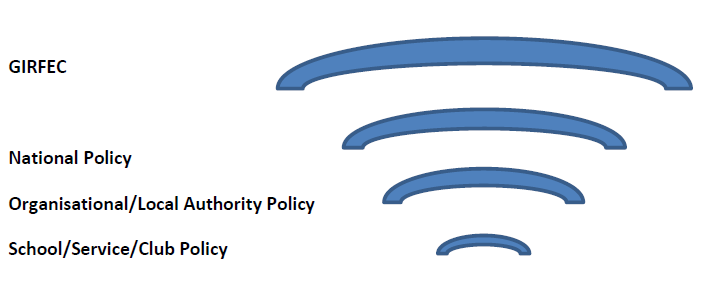
In Scotland we have a National Approach to Anti-Bullying, which sets out the Government’s expectations. A revised version of this will be launched  this year and it will be called ‘Respect for All’. respectme has influenced this a great deal and our experience of developing and implementing policy has been central to this. I will describe the rationale for the process first rather than just what you need to put in a policy.

Our approach is to support organisations and local authorities to develop anti-bullying polices that are in step with the National Approach. This means they are underpinned by the same values of fairness, inclusion and equality, and there is a consistent definition of bullying and consistent guidance on what to do when bullying happens. It means that your local authority, school and sports club should have the same definition and use the same language when talking about and when you are challenging bullying.

The 2011 evaluation of respectme highlighted that adults and young people having a shared language and understanding on bullying was critical to success and in creating environments where bullying cannot thrive. respectme  helps an organisation or a local authority to develop a strategic overarching anti-bullying policy that is cascaded to each individual service, club or school within it.

We advise on and support a process of collaboration; getting the views of children and young people, parents, adult’s, staff and volunteers. This way the policy does not just appear out of the blue and it can be launched in the knowledge that the right people were asked and included.

Experience has also shown that the most effective way to integrate this into local practice, the most effective way to ensure individual schools, clubs or service have a good and well understood policy, is for them to take the organisational one and develop their own one locally.

This policy will be underpinned by the same values, definition and crucially it will mirror the process of collaborating with children and young people, parents and staff. This should lead to a shorter local policy that starts by referencing the organisational or local authority policy. This allows schools to say, ‘Glasgow City Council states.. and at Bellahouston Academy we do this…’ or ‘Aberdeen City Council sates… and at St Mary’s our pupil council said … about bullying.’ This is taking national policy and making it relevant locally. If every school just put a copy of the local authority policy on the shelf, there would be no ownership of it, no journey embarked upon where local issues and local parents got involved and this approach is far less likely to be successful.

This is not about doubling the workload but ensuring a very robust policy framework is in place to help those being bullied and to support those who are dealing with it. So in Scotland we would expect to see an individual school, service or club with an anti-bullying policy that is developed to reflect the organisational or local authority one. respectme will help ensure the local authority or organisational policy reflects the National Approach.

This means that in practice an individual badminton club, primary school or football club can have a policy that shares the values and principles of the organisation they are part of or that governs them. That organisation should have a policy that reflects the National Approach. This consistent language and framework should benefit children and young people, their parents and cares and those who work with them. Everyone gets the same message.

So when a parent asks for the schools policy, they should get the individual school policy but also see the local authority one, as this will give greater detail on what they can expect and what routes to take. It isn’t one or the other, best practice is both. If you are a local club not part of an organisation, you governing body, such a Sport Scotland will have a policy to reference, if you are even more local and not part of this set up, you should still use the National Approach as a guide for your policy – this will ensure it is in step with the policies the same children and young people will experience at school or other places.

All of this is designed to ensure that policy is more consistent at every level, local, organisational and strategic.

There are some things you need to put in you policy whether you are an organisation, a youth club  or a school and one of these is a commitment to challenging prejudice-based bullying. Every single policy must be explicit about the Equality Act 2010 and each of the protected characteristics.  This has been covered in other blogs on this site. We know from the research we did for the EHRC that where policies explicitly mention things like homophobia biphobia and transphobia, racism, gender-based prejudice etc.  staff feel more confident to respond to this type of behaviour when they see it. The policy gives them permission to challenge and discuss these issues and crucially, raises an expectation that they will challenge prejudice-based bullying.

There was also evidence to suggest that establishments where their policy does not mention specific types of prejudice-based bullying ,  practice is not as good and both staff and children and young people felt less confidence about dealing with this kind of bullying.

Policy is a journey, a values based journey to share understanding of what bullying is and what is expected of everyone involved what behaviour you can expect and how you can expect people to respond. It gives us a framework for anti-bullying practice and something we can and should be held accountable to.

So don’t be put off, get it right, make it inclusive and that in iself is a big part of developing environments where bullying cannot thrive, why would we not do that?

For more information on what goes in your policy, visits www.respectme.org.uk

This is designed to illustrate the process and context for anti-bullying policies at every level and how we can ensure consistency in overarching values and principles from a Government level to an individual school or youth club level.


Brian


Cyberbullying – a clearer focus

I felt it was time to update some of the advice and information I have previously shared about online bullying. – As  Safer Internet Day approaches there are many articles appearing online about ‘cyberbullying’ and conferences and events taking place, dedicated only to this type of bullying.

Bullying is behaviour that makes people feel frightened, hurt, threatened and left out. It impacts on a person’s ability to feel in control of themselves (their ‘agency’) and to respond effectively. This behaviour can harm physically and emotionally and the threat is typically sustained. This behaviour takes place in a variety of places, including online.

The research I undertook in late 2014 provided a picture of what types of behaviour children were experiencing and where it was taking place. The findings confirmed what many already thought while continuing to surprise many others.

Face to face bullying accounted for the majority of bullying incidents. The three most common behaviours experienced when being bullied face to face were:

Name calling

Hurtful Comments

Rumours

8,000 children and young people from across the country took part in the research. 30% of them said they had experienced bullying in the last 12 months. Of the incidents they experienced:

60% took place in person

21% took place both in person and online

19% tool place online only

They also told us that only 6% of bullying started online – and it was usually related to something that happened in school or face to face. The behaviour  can then continue online, face to face and sometimes both.

The three most common behaviour experienced online were:

                Name Calling

                Hurtful Comments

                Verbal Abuse

This shows that there is little difference between the behaviours experienced – only where they took place.

This has helped us work with colleagues to develop local surveys and questionnaires that ask the right questions, not ‘Were you bullied’ and ‘were you cyberbullied?’ But ask ‘Were you bullied?’ ‘What was the behaviour and where did this happen?’ Children and young people were able to tell us very clearly things like ‘I was called names and this happened on the bus and on Facebook’.

There should be little focus on where it took place – it was still bullying.

The findings from the research show that online bullying is more public and more visible. This is what contributes to the notion that it is a ‘bigger’ or ‘increasing’ problem. Bullying behaviour is not always seen by lots of people – threats and manipulative behaviour still takes place largely in private – away form everyone else.  This is still the most common type of bullying; sneaky, under the radar behaviour, carried out in places where there is little or no supervision.

So what are the risks with this?

The main risk is that we have, and often still do, focus heavily on online or cyber bullying and  have almost started to ignore the less public types of bullying.  I even get asked about what has happened to ‘traditional’ bullying. We seem to have developed this notion that the only thing to be concerned about is the stuff that happens online. This is not to say what is happening online isn’t concerning, of course it is, but so is the behaviour our children and young people continue to experience face to face – and sometimes both face to face and online.

We do not need to develop specific polices for online bullying, but we need to ensure that  all of our anti-bullying policies and practices reflect that things happen both face to face and online. This approach is in line with international research and best practice. When we talk about bullying we mean bullying that happens face to face and online.

When talking to children and young people recently about new national policy they told me they found it strange that people still talked about ‘cyber’ bullying as ‘cyber’ is just not a word they use for anything.  The distinction between online and offline isn’t as straightforward as some adults may think. Relationships play out online and in person – whether chatting face to face or  on Twitter or Snapchat – it’s all talking to friends.

Young people told us some very interesting things about their lives online. The majority of young people (81%) consider their online friends to be all or mostly the same as in real life. Only 4% of the 8,000 surveyed said they did not know the people they were ‘friends’ with online.

Crucially, 92% of children who experienced bullying online knew the person bullying them. This goes some way to challenge the ever present line that anonymity is one of the driving factors behind bullying online. Young people interact and socialise with an extended network of other people they are connected to through school, family communities and friendships as well as similar interests in music or sport.

They also use social media  to communicate –the purpose of using smart phones, consoles or laptops is primarily about staying in-touch with friends, something which is as important for young people today as it was 40 years ago. They have different means at their disposal but the principle is the same.

On of the challenges we still face is the belief that if something happens onlineit did not take place in school and the school or teacher cannot do anything about it. Our advice on this has been consistent – we respond to what happened to someone – not where it happened. If a child or young person decides to inform their teacher – they are investing in them as an adult they trust to help them – that last thing we should be doing is sending them away.

I was talking to a teacher about this earlier this week and she feels frustrated that an incident that happened at a swing park between two pupils in the same class is being ignored by some colleagues because of where it took place. The school here is in a great position to help resolve this – they don’t need to do all the work but could lead on helping the children they know feel safer or behave more respectfully. It is the same if it happens on Facebook. Respond to what happened not where or when. Respond to how someone feels – that way you can role model effective ways of dealing with relationship and interpersonal difficulties.

Bullying is also about relationships – not technology.  We must focus on equipping young people with the skills to conduct themselves online in a more respectful manner; the skills to manage their environments safely, and to develop their confidence and abilities to negotiate relationships and problems. This is built on promoting and developing resilience. But we also have to equip parents with the knowledge and understanding about how social media and the other places children and young people go online work; how to make them safe and, most importantly, how to talk to their children about using them. respectme offers free training for parents on this.

‘Cyberbullying’ is bullying; it is about relationships that are not healthy or being managed or role modelled well. It is behaviour done by someone to someone else, it is the ‘where’ this is taking place that is new. The behaviour appears to be migrating, as children spend more time online, the behaviour they have always exhibited and experienced goes with them.

Adult fear and anxiety  has long been the biggest hurdle in dealing with bullying online. It has had a very high media profile at times and it appears ’new’.  For parents or adults who do not use social media or connect with their friends using the internet, this can be a challenging and, at times, bewildering experience.

Lots of colleagues have said they are ‘technophobes’ or are not ‘tech savvy’ and have voiced how much they dislike Facebook or twitter. We have maintained that if you work with children and young people or if you are a parent or carer, that is no longer good enough. You need to know! For some that will require a real effort to spend time and utilise their relationships to learn. We cannot abdicate responsibility for this to software. We need to connect and learn about how young people use the internet and the phones or laptops they access it from.

Many adults have experience of managing risk when working with children and young people, and this is a new place for us to consider. We need to be as imaginative and creative with the internet as we have been in other places.

What is not bullying?

One other phenomenon that has emerged is the conflating of all online behaviours and risks under one heading. Sexting is not bullying, it is largely a consensual thing, part of adolescents exploring relationships and attraction. Forcing someone to take a naked picture of themself or part of their body naked is not bullying, it is abusive and coercive behaviour. Threatening someone to do something sexually is not bullying – it is sexually aggressive behaviour. Some guidance in the UK had stated that grabbing a girl’s chest or putting your hand up her skirt is a type of bullying.  We  do not agree with this.  That behaviour is a type of sexual assault. We must not dilute abusive behaviour. This is not an attempt to demonise children and young people, but to address the fact that if we dilute sexually aggressive behaviour we run the risk of normalising it. People are still of the opinion that ‘bullying is a normal part of growing up’ or ‘It’s just bullying’. This is why we work closely with colleagues who work in areas of violence against women and girls particularly, to make sure we give a consistent message that sexually aggressive behaviour is never acceptable and, while bullying and abusive behaviour can be linked, they are not the same thing.

There have been high profile examples of blackmail, extortion and threatening behaviour online that have been referred to in the media as cyberbullying.  We need to be clear about what we are talking about.  If someone is targeted, and forced to hand over money under the threat that someone will release pictures of them, they are being criminally extorted – not bullied. Using the term ‘cyberbullying’  to describe a host of other abusive behaviours only adds to the fear and confusion on how to respond.

As we move forward we must ensure that we focus on the fact that when we talk about bullying, we are talking about behaviour that happens online and face to face.

Brian

Parents and carers – responding to bullying

This blog contains some of the supporting advice we have given to parents and carers about how you actually respond to bullying – the processes we need to go through and to include children and young people going forward to help them regain a sense of control ands influence over their lives.

How do I know if it’s bullying?

When we talk about bullying we are talking about something that is both behaviour and impact. Behaviour that can make people feel hurt, frightened, scared, left out or worried – and the impact of this behaviour leaves them feeling less in control of themselves.

We know that bullying takes something away from people; that is one of the things that makes it different from other behaviours. It takes away people’s ability to feel in control of themselves and to take effective action.  We callthis our agency. Bullying strips away a person’s capacity for agency.

It’s important to remember this when we respond to bullying behaviour.  If we can accept that it takes something away from someone, our focus has to be on helping them to get it back; helping them get back that feeling of being in control and being themselves again. That’s why we have to involve young people in what they want to happen, what they would like to happen, and what they are worried about happening. 
And sometimes we need to take a lead from them as to what pace we go at. If we can do that, we can help restore that feeling of being in control. 

We are teaching children very important life skills.  We are teaching them to negotiate difficult relationships and that’s a factor of life for everyone.  It’s a skill we all need as adults, to learn how to get on with people and to learn how to dislike someone in a respectful manner.  That’s how we approach bullying.

What advice should I give?

Hearing that your child is being bullied brings out an understandably emotional response. It’s difficult for parents and carers to hear.  It’s difficult because you feel so strongly about it and when you hear your child is being bullied, you are not always at your best.

Sometimes the advice we give children and young people at this time isn’t necessarily the best advice. Being told to hit someone back if you are being bullied is actually a common response; children and young people have told us this is something they hear. We know it exists as an option to use but we know, by and large, it’s not necessarily the best or safest option to take.

It doesn’t take into account people that can’t or won’t hit back; people that have mobility problems or who are too scared, or people who won’t like the thought of violence.  So there always has to be an alternative to it. We don’t go through life answering challenges and relationship difficulties by resorting to violence, yet we tend to tell children if they are being bullied they should hit back – whether they are being physically bullied or bullied online, that’s the advice we tend to give.

There is never one, single, answer when it comes to bullying, it’s about knowing how to think about it and how to approach it.

Sometimes you have to ask your child, ‘what do you want to happen?’
‘tell me what you have done so far?’
‘what would you like me to do?’
‘what do you think would happen if, say, I was to go up to the school and talk to them about it?’.

If they are worried that you would make it worse, you might have to try something else because most children want bullying to stop with the minimum of fuss.
‘What do you think would happen if I spoke to someone’s mum?’ or
‘is there someone else you can talk to?’

It’s about exploring options; thinking about what you can do and sometimes having to say, as a parent, ‘look if I’m worried and I don’t think you’re safe, I’m going to step in’, and explain why you are doing it.

This process of exploring what you can both do role models a way of thinking and the aim is to agree a way forward – a plan you can agree to and agree to review if it’s not working. You will have a positive impact on their anxiety levels as they can discuss things with you and they can see your desire to help rather than you being angry or upset. It is not about as a parent or carer having all the answers – it is about asking each other questions, talking and most importantly listening, to get closer to an answer together.

Listening isn’t always easy – especially if we are emotional but the one thing children and young people have told me consistently over the years is that they want listened to when they are being bullied.

The temptation to run off and solve it is an understandable one, but we should always take a moment, pause and think, ‘how do I give my child back a sense of being in control?’ because it’s that sense of being in control that has been taken from them, and that has to focus your response. Sometimes your child might ask you not to do anything straight away – to give then the chance to go back into school and see how things are.
 

What if my child is bullying someone else?

If your child has been accused of bullying or you suspect your child is bullying, you have to address their behaviour and the impact that it has had. Children who are bullying others need help to repair relationships; they need help to understand that what they’ve done is wrong. Sometimes they know the impact of what their behaviour is; that’s why they’re doing it, but sometimes they need help to understand the effect their behaviour is having on someone else.

It’s important when we deal with children who are bullying that we don’t label them.  We talk about their behaviour and we talk about the impact that it has, we don’t label them as bullies. There isn’t any one stereotypical ‘bully’.  Bullying is behaviour that makes people feel a certain way – and many of us will have acted in a certain way that made someone feel hurt, frightened or left out. It’s much easier to change your behaviour if I say, ‘when you did that to him, that was bullying’. I’m much more likely to get a better response then if I say, ‘because you did that, you are a bully’.

People won’t recognise that label, parents will object to that label and you don’t change behaviour by labelling people. You change behaviour by telling people what they did, why it was wrong, and what you expect instead.

Children and Young People’s Mental Health in Scotland – some context

This is a copy of the speech I gave to a group of ‘Trusted professionals’ in Glasgow this week. These professionals provide tailored support to young people in the form of ‘Activity Agreements’.  these focus on developing skills, capacities and getting young people into positive destinations. Mental Health was becoming an increasing issue for them and they wanted some input on the context for this work in Scotland – which I was happy to try and provide.
 
I was asked to come along today to provide an overview of children and young people’s mental health – to give an overview of the context in Scotland – which I will do. I will talk briefly about the national strategy, the national indicators, the curriculum for excellence and GIRFEC.
 
I was also asked to reflect on approaches or support that can be offered – that is where the conversation expands considerably. There are as many approaches and models as there are diagnosed conditions and they cannot be covered by an input such as this –the truth is the journey of building our own capacity to recognise and respond to mental health issues never ends. Reading, training, workshops, partnerships – these things all build our capacity and that is what I hope to contribute to today.
 
I am pleased to see children and young people’s mental health is on your agenda and I realise for some – it is new to you and can see why you wanted it be able to reflect on it today.
 
Understanding mental health is not about you diagnosing ADHD, Bi-Polar disorder or necessarily recognises an eating disorder immediately – but about being comfortable that you have the skills and knowledge to respond and engage with other medical or professional services.
 
The time you spend with a young person and what you see matters. That’s what the ‘experts’ need to ask or expect from us – to describe how someone behaves – what do they do? – We should not be prevented from contributing because we can’t make a formal diagnosis.
 
You work with teenagers – not feeling good about themselves, being moody and uncomfortable around adults is their job. Some of the young people you work with from your own data, have additional support needs, have been involved in offending, some will or will have been looked after and some use drugs and alcohol. 
 
When I read this data – I did think to myself –of course mental health is going to be an issue with the young people you work with!
Care leavers in particular are up to 5 times more likely to have a diagnosed mental health problem when they leave care – this is due to a number of factors -as is the case for most young people who are marginalised or struggling with some of the issues that lead the them needing a service form you.
 
This includes things like life events, trauma, separation, poor attachments, developmental difficulties that could be genetic too, neglect or parental mental health or illness. These are all things that affect a person’s well-being and can develop into diagnosed mental health conditions or they can exacerbate underlying conditions. These all affect behaviour and can lead to anger, anxiety, self-harm, eating disorders. You deal with behaviour and all behaviour communicates feelings. That’s what we understand best – in my opinion.
 
This matters in your role as mental health is a major cause of absence at work and to people being unable to work or being stigmatised and discriminated against. We also know that many mental health problems begin and develop in adolescence – they don’t just appear on adults – yet services and legislation are still largely set up that way.
 
So, to the context for all of this.  The over-arching context that underpins all of what we shall explore next is GIRFEC – Getting It Right for Every Child is something I am sure you are well aware of –this framework for outcomes compliments the Mental Health Strategy for Scotland, The National Indicators for Children and Young People and The Curriculum for Excellence and so on. All of this should in theory ensure all children are safe, happy nurtured and son on.
 
We have in Scotland a Mental Health Strategy – one that ran from 2012 – 2015. and one that runs form 2017 – 2027. This document sets out the Scottish Government’s priorities and commitments to improve mental health services and to promote mental wellbeing and prevent mental illness. the 2017 one sets out 40 Actions and can be found here  – 
 
These are designed to reflect Government ambitions and National Outcomes so that we can ‘live longer healthier lives’ ‘tackle inequality’  and ‘services are responsive to people’s needs’  – High level outcomes Government ambition (Longer healthier lives) directly impact national policy and strategy which impact money and resources and impact on funding and the desired outcomes funders are looking for you to deliver – it is much easier to argue the case to government when you can easily contextualise your work and ambition in the context of their outcome framework – that’s the language they understand.
The Government has a vison that by 2020 (it’s called the 2020 vison) that sees health services delivered in communities with people at the centre – it encourages health promotion and prevention – and that is where most of you sit – making this a reality that doesn’t focus on medical approaches has still to be achieved.
 
The Mental Health Strategy identifies seven key themes, which emerged from the consultation process
 
Working more effectively with families and carers
 
Embedding more peer to peer work and support
 
Increasing the support for self-management and self-help approaches
 
Extending the anti-stigma agenda forward to include further work on discrimination
 
Focusing on the rights of those with mental illness
 
Developing the outcomes approach to include personal, social and clinical outcomes
 
Ensuring that we use new technology effectively as a mechanism for providing information and delivering evidence based services
 
Four Key Change Areaswere also identified
 
Child and Adolescent Mental Health
 
Rethinking How We Respond to Common Mental Health Problems
 
Community, Inpatient and Crisis Mental Health Services
 
Work with Other Services and Populations with Specific Needs
 
Activity to Support Delivery of the Mental Health Strategy
 
Again you can see this is very medically focussed and children and young people are one of the 4 areas. I feel that sometimes children and young people are relevant in each of the 4 – you can’t just relate them to adults and then just have children’s mental health as a category all of their own.
The other side of the coin is it is finally recognising a need to focus on children and young people’s mental health and it is an area that requires renewed focus.
 
One of the aims of the strategy is that children and young people, following a referral for specialist CAMHS treatment get seen within 26 weeks.
 
A large amount of the strategy focusses on CAHMS interventions and the CAMHS works force –some of it is moving into community based work and partnerships but it is still largely led by a medical model or a deficit model on mental illness and less on the promotion and prevention.
 
It is something we should read if children’s mental health matters to us – it clearly does and it shapes the partnerships we can develop and the work done by colleagues.
 
Part of the on-going work to improve mental health in Scotland was to develop a set of national indicators on mental health – one was developed for adults initially and subsequently one for children and young people – I was on the advisory group for children and young people and it was quite a challenge – doctors, physicians, psychologists, researchers, professors and me! Making up the numbers and representing the voluntary sector social work types.
These indicators were finalised in late 2011 and set out a range of mental health outcomes – things that contribute to mental well-being and to mental health problems and arrange of contextual factors such as family, environment, community, learning environment etc.
 
This is the graphic that illustrates the framework.

The idea is that data can be measured through surveys, existing research, suicide and hospital statistics and specialist tools such as a Strengths and Difficulties questionnaire to give an overall picture of mental well-being and also mental health problems in Scotland – this is then supported by an analysis of contextual factors through surveys, research and data on the contextual factors, health and behaviour in schools surveys, both national and local ones.
 
The first analysis of these was completed in 2013 and indicated that children’s mental health has improved or stayed broadly consistent on the last 10 years – it shows contextual factors like alcohol consumption is down but the units consumed by those drinking going up for example.
 
These trends and data are to be used to influence policy and practice and to challenge and inform media colleagues.
 
The one other area that contextualises work around mental health is the Curriculum for Excellence – significantly the health and well-being outcomes within this. This is what colleagues in schools will be working within and setting lesson plans etc. around. What is new and positive about the curriculum is traditionally literacy and numeracy were the responsibilities of all – well-being sat with guidance and pastoral care – this is no longer the case – all teachers have a responsibility to include and consider how their work, relationships and lessons impact on health and well-being. It recognises that in order to learn and to and develop confidence requires a focus on our mental well-being – this will not be rocket science or news to any of you but it does radically change the paradigm for colleagues in schools.
 
It’s no longer good enough for the history teacher to just teach the history curriculum, they have to be tuned into and recognise the things that can impact on a child’s well-being and their learning. They are expected to promote a culture of respect and trust.
 
I have given inputs to teachers who are just as concerned about what is expected of them as you are – just as concerned that they are worried they will need ot teach lessons or deal directly with the treatment of mental health problems. The message is the same – it’s about being confident to recognise when something isn’t right or a person has changed and knowing where ot go and what to do – who to talk to and where to get help. Signposting and having knowledge of what resources are in your area is vital.
 
Health and well-being extends to food and nutrition, exercise, relationships as well as feelings, anxiety, fear, and mental health problems. The health and Well-being outcomes that teachers use should address issues such as managing relationships, developing resilience, dealing with difficulties, expressing yourself and getting active.
 

This graphic highlights the tools colleagues should be using to plan and deliver learning and making sure these outcomes are the focus.
 
For me, this is the first time education and social work has had a 
similar value based approach to outcomes for children and young people.
 
So as you can see- there is quite a bit of context for the work you do – I haven’t even drilled into parenting strategies or suicide and self-harm or anti-bullying strategies – that all reflect the same values and ambition. There are many of these that can give you access to more detail on how to respond, what works, what good practice looks like, where to get help – the challenge is to familiarise ourselves with the practice and the policy context that affects us and assimilate this into our work.
 
You will learn more about dealing with self-harm when you are dealing with self-harm than you can from having a theoretical understanding of it – this can help it can ensure your first response is a more informed one – same with bullying, same with Bi –Polar disorder or depression. Reflective practitioners learn from their experience – we absorb influences, research, books, advice and guidance with our experience and we us all this to formulate plans and approaches to issues.
 
I think we should be more comfortable at times with the fact we are always learning and always on a journey – not feel we can’t contribute because we are not experts on the minutia of a particular mental health issue- you will be presented with a huge variety of behaviour – there may be some similarities but every child is unique and their issues will be unique to them, where they live, who they live with and where you fit in.
 
The impact of Mental Health problems
 
It is important to just reflect on the impact of metal health on children and young people
 
Stigma
 
Discrimination – these can be immobilising – they are still experienced more from close family and friends
 
Relationships affected – friends can turn away – young people might struggle with how to manage ups and downs – tension can result
 
Life Chances – you miss school and you get no qualifications – your options are limited –the choices you can make are affected
 
Employability – it can impact on attendance at work and the stigma can prevent people from gaining work
 
Drug and Alcohol use – can be a contributor as well as a symptom
 
Developmental delays – some conditions can result in developmental delays and affect conative functions
 
Behavioural problems – as a result of not being able to communicate effectively – or feeling the stigma
 
Physical health – to take part in things like PE, to want to or even be able to –side effects of medication or treatment
 
Motivation – can’t get out of bed!
 
These just some of the impacts – I’ve put motivation in as you will work with some young people who for the moment actually can’t get out of bed – they’ve not yet been diagnosed with depression but all the cajoling on the world won’t address what’s going on – threats will have no impact.
You might also be working with someone who can’t get out of bed because they are not used to it and hate getting up – and cajoling and threats might be the order of the day. There is no one answer for things like this except to try and see the whole person and what their behaviour communicates in the broadest sense and to consider mental health when doing this – for some of the people you work with this will be a first.
 
What we do know is this – A strong relationship with a trusted professional – I don’t just mean the formal role of ‘trusted professional’ but one good positive relationship can make all the difference – there is no shortage of research into brain development in early years – Dr Harry Burns’ stuff is fascinating on how neural pathways are joined up through positive attachments and stimulation and how brain development can be affected by the absence of these – the crucial message he gives, as do many others  is that this ‘damage’ is not beyond repair – adolescents can and do through positive relationships learn to trust , to stretch themselves and grow.
The skills that underpin effective relationships are the ones we use and the ones others need to learn – especially the medical professionals – they have things to learn from you.
 
As I said at the start of this – it is just not possible to cover the area of children and young people’s mental health fully – if affects every single pat of who they are and what they do
 
If you are a social worker – you must consider mental health in your work and decisions
 
If you are a teacher – you must consider mental health in the same way
a youth worker, a classroom assistant, a criminal justice social worker, a foster carer, a residential worker- we don’t always need the ‘expert’ to deal with this aspect of a child’s life
 
There is no health without mental health – we all have mental health – it will be better at some times than others – we will need different things form the people around us depending who we are – what happened and when.
Our response will be dependent on our levels of resilience – did we have interests out of school, someone who cared and went the extra mile, somewhere we knew we belonged and were helped to learn from our experiences.
 
This job – this role gives you the chance to be that person for someone who needs it.


Thank you for listening folks – enjoy the rest of today.